
Here’s the thing about Panama that most expat guides get wrong: they sell it as a budget destination. It isn’t. Panama City costs more than Medellín or Cuenca; rent is higher, imported goods are pricier, and eating out at decent restaurants adds up fast. But the people moving to Panama in 2026 aren’t shopping for the cheapest option in Latin America. They’re shopping for the most stable one.
The USD economy means zero currency risk. The Pensionado visa offers permanent residency with a $1,000/month pension requirement and discounts on nearly everything. A 3-hour flight connects you to Miami. And Hospital Punta Pacífica (JCI-accredited, Johns Hopkins–affiliated) sits in Panama City for when your health requires something serious. No other country in the region bundles those advantages together.
That said: Panama is hot, banking is harder than it should be, and the Friendly Nations Visa got considerably more restrictive in 2021. This guide gives you the current reality: what Panama costs, how to get residency, where to live, and the practical steps to actually make the move. Not a sales pitch.
Why People Are Moving to Panama (And Why Some Aren’t)
The Case For
The dollar. Panama uses USD as its currency: the Panamanian balboa is pegged 1:1 and rarely seen in practice. For Americans, this is genuinely significant: no exchange rate risk, no watching COP or USD/CLP swings eat your purchasing power, no mental math at the grocery store. If you’ve lived in Colombia or Ecuador and watched currency fluctuations affect your monthly budget, the psychological relief alone is real.
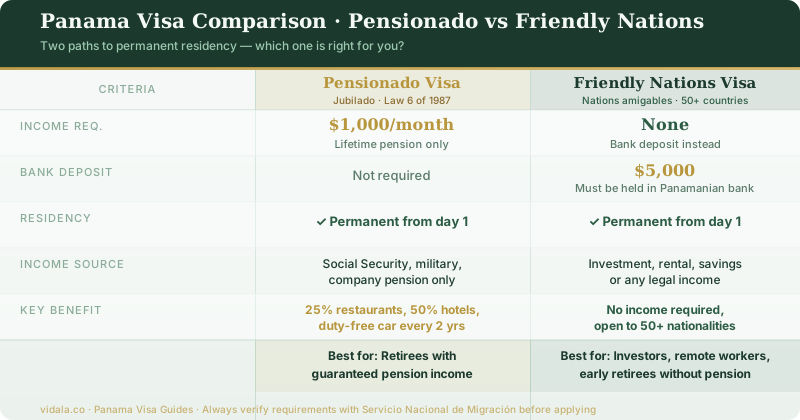
The Pensionado program. Panama’s retirement visa has no equivalent in Latin America. With proof of $1,000/month in lifetime pension income (Social Security, military pension, corporate pension), you get permanent residency on approval; no 2-year provisional period, no annual renewal. The discount ecosystem is the other draw: 25% off airline tickets, 20% off doctor visits, 15% off hospital bills, 50% off entertainment. These add up over years.
Tax structure. Panama’s territorial tax system only taxes income earned within Panama. Foreign Social Security, US rental income, remote work for foreign companies, dividends from foreign investments: none of it is subject to Panamanian income tax. There’s no wealth tax, no capital gains tax on foreign assets, and no inheritance tax. For high-income retirees or business investors, this is a serious financial reason to choose Panama over Colombia or Ecuador.
Proximity to the US. Three hours from Miami on Copa or American. US goods are widely available. English is spoken throughout Panama City’s business and expat neighborhoods. The cultural gap is smaller than anywhere else on this list.
Infrastructure. Panama City genuinely surprises people. Fiber internet is standard in most neighborhoods ($40–$70/month). The Metro is clean and cheap. Modern hospitals, decent roads, and reliable utilities: the kind of urban functioning you take for granted in developed countries but get frustrated by elsewhere in the region.
Honest Downsides
It’s not cheap. A comfortable one-bedroom in El Cangrejo (the main expat neighborhood in Panama City) runs $800–$1,500/month. Budget $1,800–$2,800/month total for a comfortable single person’s life in Panama City, $2,800+ for a couple. That’s 30–50% more than Medellín and roughly double what you’d spend living well in Cuenca, Ecuador.
The heat. Panama City is tropical. Year-round temperatures run 85–95°F (30–35°C) with high humidity. Air conditioning is not a luxury; it’s a utility, and it shows up in your electricity bill ($80–$200/month depending on usage). If you already dislike heat in the US, Panama City will wear you down faster than you expect.
Banking KYC. The Panama Papers scandal and Panama’s subsequent FATF grey-listing (2019–2023) hardened the banking system’s attitude toward foreigners. Opening a local account without residency is possible but increasingly difficult; many banks decline outright. Tower Bank and Multibank have reputations for being more expat-friendly, but even they’ll want residency documentation, proof of income, and sometimes reference letters. Plan to use Wise and a Charles Schwab debit card for your first year.
Language outside the capital. Panama City is manageable in English for daily life. The rest of the country is not. In Boquete you’ll be fine in the expat community, but basic Spanish is expected for anything beyond that. Interior Panama requires Spanish.
Rainy season. May through November, Panama gets heavy rain; daily afternoon downpours, sometimes all day. It doesn’t ruin life, but it’s real, and it limits outdoor plans for six months of the year.
Who Panama Is Best For
Retirees with pension income above $1,000/month are the obvious fit: the Pensionado program was built for them, and they get the most from it. Business investors and high-income remote workers benefit from the territorial tax system. People who want US-adjacent living (flights home, English widely spoken, familiar goods) without paying US prices.
Panama is not ideal for travelers on tight budgets, people seeking deep cultural immersion in local communities, or anyone who genuinely dislikes tropical heat. Medellín or Cuenca are better fits for those.
Visa Options: How to Live in Panama Legally
Pensionado Visa (Retirement Visa)
The most coveted visa in Panama. The requirements are stricter than most guides acknowledge:
Income: $1,000/month minimum from a lifetime pension; government-issued, not from bank accounts or private investments. Social Security, military pensions, and corporate pensions qualify. A $300,000 government investment fund that pays dividends does not. Many applications are rejected because the income source doesn’t meet this standard. If you own Panama real estate worth $100,000+ registered in your name, the threshold drops to $750/month.
Documents required: Police clearance from your home country (apostilled), medical certificate confirming freedom from contagious disease, official pension letter from the issuing government agency. Everything must be apostilled and translated by a certified translator. Documents can’t be older than 6 months at submission.
Processing time: 4–6 months from a complete file submission. Some attorneys report faster: 30–90 days when paperwork is spotless, but count on 6 months for planning purposes.
What you get: Permanent residency, immediately on approval. No annual renewal. Pensionado discounts on healthcare (20% off consultations, 15% off hospital bills, 10% off prescription drugs) and daily life (25% off airline tickets, 50% off entertainment). You must spend at least one day in Panama per calendar year to maintain it.
→ Full Panama Pensionado Visa guide
Friendly Nations Visa
This was once the easiest path to Panama residency for working-age Americans and Europeans. The 2021 reforms changed that substantially. The current program grants 2-year provisional residency, after which you apply for permanent residency: a total path of roughly 3 years.
The three qualifying routes are all substantial commitments:
| Route | Requirement |
|---|---|
| Fixed-term deposit | $200,000 CD in a Panamanian bank, locked 3 years minimum |
| Real estate purchase | Property valued at $200,000+ |
| Local employment | Job offer from a Panamanian company with 10+ Panamanian employees, registered with Social Security |
Government fees are around $1,250 per applicant. Budget $2,000–$4,000 in attorney fees on top of that.
If you were planning to form a Panama company with a minimal bank deposit; that was the old FNV, and it’s been dead since 2021. The program still exists and still works, but it now requires genuine economic commitment.
→ Full Friendly Nations Visa guide
Tourist Entry (The Starting Point)
Most qualifying nationalities (including US, Canadian, UK, and most EU citizens) get 180 days of visa-free entry per visit. Not 90. That’s enough time to do a real scouting trip, settle into a neighborhood, consult with immigration attorneys, open preliminary banking relationships, and still return home to organize before committing.
You can’t legally work on tourist entry, and “border runs” to Colombia or Costa Rica to reset your stay are technically a gray area under current immigration enforcement (Executive Decree 15 tightened enforcement in January 2025). Treat the 180-day period as a planning runway, not a permanent solution.
Other Pathways
Real Estate Investor Visa (2025): A separate route from FNV; $300,000+ property purchase earns 2-year temporary residency, converting to permanent after 3 years. Distinct from the FNV real estate option.
Self-Employed / Professional Visa: Available for specific professions with Panamanian employer or business registration. Complex; hire a local attorney.
Path to citizenship: 5 years of legal residency qualifies you to apply for naturalization. Panama allows dual citizenship; you don’t have to renounce your original citizenship.
Applications go through the Servicio Nacional de Migración. Hiring a Panama immigration attorney is not optional boilerplate; it’s genuinely necessary. Budget $1,500–$3,000 for legal fees on top of government costs.
Where to Live in Panama
Panama City
Panama’s capital is the default landing point for most expats, and for good reason. It has everything: JCI-accredited hospitals, international schools, direct flights everywhere, 24-hour pharmacies, and a restaurant scene that would hold its own in most European cities. It also has the country’s best internet, most reliable utilities, and largest expat community.
El Cangrejo is where most new expats land. Walkable, central, mid-market. Good selection of cafes, restaurants, and supermarkets within walking distance. A furnished 1-bedroom runs $800–$1,500/month: the best value you’ll find in a genuinely convenient central location.
Punta Pacífica is the premium district; oceanfront high-rises, hospital nearby, views of the bay. Expect $1,500–$3,000/month for a 1-bedroom. Better for retirees or professionals who want the nicest building and don’t mind paying for it.
Albrook is the former US Canal Zone neighborhood; green, spacious, suburban feel. Popular with families. Rents run $900–$1,800/month, and there’s an American-suburb quality to the streets that some expats love and others find sterile.
Costa del Este and San Francisco are modern, well-maintained, popular with professionals. Rents are higher than El Cangrejo; $1,200–$2,500/month, but buildings are newer and the infrastructure is solid.
The areas to avoid for residence: parts of Colón (the Caribbean port city, higher crime throughout), El Chorrillo, Curundu, and parts of San Miguelito. Your real estate agent or attorney will know the current situation on the ground; ask directly.
→ Panama City cost of living breakdown
Boquete
If Panama City’s heat is a dealbreaker, Boquete solves it. Sitting at 3,900 feet in the Chiriquí highlands, temperatures stay between 65–75°F year-round. The expat community is dense: a small town of around 25,000 people with a North American retiree presence that means coffee shops, English-language social groups, and neighbors who’ve already figured out the local healthcare system.
A furnished 1-bedroom in Boquete starts around $500–$800/month. A realistic couple’s budget including a furnished 3-bedroom house, groceries, a car, health insurance, and dining out: $3,000–$3,500/month. No air conditioning bill.
The tradeoffs are real. Serious medical care requires the drive to David (45 minutes) or a medical flight to Panama City. Urban amenities don’t exist. You need a car. If you’re accustomed to city living, Boquete can feel small after a few months. But for retirees who want nature, community, and cool weather, it’s hard to match in Latin America.
Bocas del Toro
An archipelago on Panama’s Caribbean coast; turquoise water, beach bar scene, cheap accommodation by Panama standards. The expat community trends young and transient. Infrastructure is genuinely limited: power cuts happen, internet can be unreliable, and the nearest serious hospital is hours away. Some people love it for exactly these reasons. Retirees who need regular healthcare access should not plan to live here full-time. → Bocas del Toro expat guide
Coronado, El Valle de Antón, and Pedasí
Coronado is a Pacific beach town about 80 km from Panama City; popular with Pensionado retirees who want beach life but occasionally need the capital. Gated communities, good road access, some English-speaking services.
El Valle de Antón sits in the crater of an ancient volcano, 2 hours from Panama City. Mountain town, popular as a weekend retreat for Panama City residents. Some full-time expats, but it’s a small community.
Pedasí is a small Pacific fishing town with a growing expat presence and good surf nearby. Remote, limited services, but inexpensive and increasingly popular with people who want to get out of the capital for good.
Cost of Living in Panama
Panama is not Latin America’s budget destination. Be clear about that before you start planning.
| Expense | Panama City (comfortable) | Boquete | Notes |
|---|---|---|---|
| 1BR furnished apartment | $800–$1,500/mo | $500–$800/mo | Wide range by neighborhood/building |
| Groceries (one person) | $250–$350/mo | $180–$280/mo | Imports are expensive; local produce cheap |
| Eating out (local restaurant) | $6–$10/meal | $4–$7/meal | Fondas offer best value for lunch |
| Electricity | $80–$200/mo | $30–$60/mo | AC is the #1 cost variable in Panama City |
| Internet (fiber) | $40–$70/mo | $30–$50/mo | Reliable in both cities |
| Health insurance | $100–$300/mo | $100–$300/mo | Required for Pensionado visa |
| Monthly total (comfortable single) | $1,800–$2,800 | $1,400–$2,000 | All USD, no currency math |
The big advantage no table fully captures: since Panama uses USD, you don’t have a currency cost. No Wise fees to convert your paycheck. No watching the COP slide 5% while your rent stays fixed in local currency. That stability is worth real money over time, and it’s the primary reason Panama costs more in absolute terms than Colombia: the premium buys peace of mind that Medellín doesn’t sell.
Banking in Panama
This is the section most guides gloss over. Here’s the honest version.
Panama has a large, sophisticated banking sector; around 60 licensed banks, including branches of major US and international institutions. But post–Panama Papers scrutiny and a FATF grey-listing that lasted from 2019 until Panama was removed in 2023 made banks far more conservative about opening accounts for foreigners.
Before you have residency: Local banking is difficult. Most banks require residency documentation for personal accounts, or will require a non-resident minimum deposit of $1,000–$5,000 and may still decline. Don’t count on walking in with a tourist visa and opening an account easily.
Bridge banking that works:
- Wise for receiving and sending USD internationally; $7.41 fixed fee per wire transfer (no FX spread since Panama is USD), which makes it very cost-effective. Set this up before you arrive.
- Charles Schwab international debit card: no foreign ATM fees worldwide, reimburses ATM charges. The standard recommendation for expats pre-account.
Once you have residency: The process gets meaningfully easier. Bring your cedula, proof of income, proof of address, and if possible a reference letter from your home bank. The banks with the strongest expat-friendly reputations are Tower Bank and Multibank: both have English-speaking staff and more flexible documentation processing. Banistmo (a Bancolombia subsidiary) and Banco General are larger and more established but more bureaucratic with foreigners.
Pensionado holders often find the process easier because their residency documentation is particularly clear; government-issued pension letter plus permanent residency status tends to satisfy KYC requirements cleanly.
Healthcare in Panama
Panama City has Hospital Punta Pacífica: now officially branded as Pacífica Salud; which holds JCI accreditation and is the only hospital in Central America affiliated with Johns Hopkins Medicine International. Around 250 doctors, most trained in the US or Europe, and a significant portion are English-speaking.
Current prices at Pacífica Salud: GP consultation $50–$60, MRI ~$600, teeth cleaning $25, dental crown ~$500, dental implant ~$1,500. Those are 40–70% less than US equivalent prices for routine care.
One caveat worth being honest about: routine care and elective procedures are genuinely affordable. But extended hospital stays, ICU care, or complex cardiac and oncological procedures at Pacífica Salud can generate bills that approach US levels. Carry international health insurance regardless of how healthy you are.
For insurance, SafetyWing Nomad Insurance is a workable starter; from around $47/month for under-40, rising with age, and satisfies Pensionado visa health insurance requirements. Once settled, many expats transition to local Panamanian insurers like ASSA or Humana Panama for more comprehensive coverage.
Outside Panama City: David (Chiriquí province, 45 minutes from Boquete) has decent regional hospitals. Boquete itself has basic clinics and a few general practitioners. For anything serious, plan on Panama City.
Dentistry is worth a separate mention: Panama City dentists trained at Panama or US schools deliver work that’s 40–60% less than US prices. Many US retirees specifically factor dental care into their decision to move. → Healthcare in Panama for Expats
Safety in Panama
Panama consistently ranks as one of the safer countries in Latin America. Numbeo’s crime index puts Panama at 42.7 out of 100 (2025); well below Colombia, Mexico, and most of Central America. The 2024 homicide rate was approximately 13 per 100,000 inhabitants, which is higher than the US (6.3/100,000) but far below countries like Honduras or Jamaica, and concentrated in specific areas rather than spread across the country.
In Panama City, the relevant distinction is between expat neighborhoods and everything else. El Cangrejo, Punta Pacífica, San Francisco, Albrook, and Miraflores have low violent crime rates; residents report the kind of urban experience you’d expect in a mid-size European city. Colón, the Caribbean port city, is genuinely dangerous; don’t live there and don’t visit alone. El Chorrillo and Curundu in Panama City are areas to avoid.
The main crime affecting expats in safe areas is petty theft: phone snatching, pickpocketing on buses, car break-ins. Don’t leave bags visible in parked cars. Stay aware in markets and crowded areas. These are the same precautions you’d take in Miami or Madrid.
Boquete and the interior are very safe. The North American retiree community there has had a presence for 20+ years, and violent crime against expats in those areas is extremely rare.
US citizens should register with the Smart Traveler Enrollment Program (STEP); it’s free, takes 10 minutes, and means the US Embassy in Panama City can contact you in the event of an emergency.
Taxes in Panama for Expats
Panama’s territorial tax system is straightforward: Panama taxes only income earned within Panama. Everything earned outside the country; US Social Security, remote work for foreign employers, dividends from a US brokerage, rental income from a US property; is exempt from Panamanian income tax.
For US retirees with Social Security income living on Pensionado: zero Panamanian income tax on that pension. For remote workers employed by US companies: zero Panamanian tax on that salary (services performed outside Panama = foreign-sourced income). For investors with US dividends and capital gains: zero Panamanian tax on those.
Panama also has no wealth tax, no inheritance tax, and no capital gains tax on foreign assets.
US citizens: you still owe the IRS. The US taxes citizens on worldwide income regardless of where they live. But two tools offset this meaningfully:
- Foreign Earned Income Exclusion (FEIE): Excludes up to $128,200 (2025) in foreign earned income if you meet the bona fide residence test or 330-day physical presence test.
- Foreign Tax Credit: Offsets US tax with any Panama taxes paid (relevant primarily if you have Panama-sourced income).
You’ll also need to file an FBAR (FinCEN 114) if your total foreign account balances exceed $10,000 at any point during the year. Note that there is no US-Panama tax treaty, which creates some gaps a qualified US expat tax accountant can help you navigate.
Property tax in Panama applies to real estate, but primary residences valued under $120,000 are exempt. For most expats buying mid-range condos, this is a real benefit.
Moving to Panama: The Practical Steps
Planning to move in 2026? Here’s the sequence that actually works:
-
Research phase (you’re doing it now). Read this guide, the visa guides, and the cost of living breakdown for wherever you’re considering.
-
Do a 30–60 day scouting trip. Panama gives most nationalities 180 days on tourist entry. Use at least 30–60 days to actually live in Panama City and, if relevant, Boquete; not to tour them. Stay in an apartment rental in El Cangrejo, cook sometimes, walk to the grocery store, work from a café. This is how you find out whether you actually want to be there. For your first month, Booking.com has solid apartment inventory in El Cangrejo and Boquete; useful while you search for long-term housing.
-
Choose your visa path. Pensionado if you have qualifying pension income above $1,000/month. Friendly Nations if you’re prepared to make a $200,000 investment or secure local employment. Consult an immigration attorney during your scouting trip; initial consultations are $100–$200 and worth every dollar.
-
Set up bridge banking. Open a Wise account and load it before you leave the US. Get a Charles Schwab international debit card (apply 6–8 weeks in advance: the process takes time).
-
Get health insurance. Required for Pensionado visa documentation; strongly advisable regardless. SafetyWing works for the visa requirement and as an initial policy.
-
Hire an immigration attorney. Budget $1,500–$3,000 for Pensionado or FNV applications. Shop by referrals from expat forums and Facebook groups: the quality variance is significant.
-
Submit your visa application. Timeline from complete document submission: 4–6 months for Pensionado, similar for FNV.
-
Open a local bank account. Once you have your cedula (residency card), approach Tower Bank or Multibank first. Bring residency documentation, proof of income, proof of address, and ideally a bank reference letter from your US institution.
-
Register with the US Embassy. Free, takes 10 minutes via the STEP program. Gives you a direct line to consular support if you need it.
Frequently Asked Questions
Is Panama really tax-free for expats? For foreign-source income, yes; Panama’s territorial system doesn’t tax it. US citizens still file US returns and pay US tax on worldwide income, but the Foreign Earned Income Exclusion and Foreign Tax Credit reduce or eliminate double taxation for most people. Consult a US expat tax accountant for your specific situation.
How long does it take to get Panama residency? Both Pensionado and Friendly Nations Visa typically take 4–6 months from complete document submission. Working with an experienced immigration attorney reduces the chance of document errors that cause delays.
Can I buy property in Panama as a foreigner? Yes, with no restrictions on foreign ownership. Titled (fee simple) property is strongly recommended over “rights of possession” land; consult a Panama real estate attorney before any purchase.
Is Spanish required to live in Panama? Panama City: less critical than elsewhere in Latin America; English is widely spoken in expat neighborhoods, business settings, and at most services that expats use. Boquete: the expat community means English is common. Interior Panama and outside those areas: Spanish is necessary.
Is Panama safer than Colombia? By most metrics, yes; lower crime index, lower homicide rate, more political stability. But Panama City and Medellín’s El Poblado have similar expat safety profiles: comfortable in the right neighborhoods, requiring awareness in others. Neither is dangerous if you know the map.
Can I work in Panama as an expat? Formal employment requires a work permit, which is complex to obtain and tied to specific employers. Remote work for foreign companies; which is what most digital nomads are doing; is a legal gray area that most expats navigate without issue in practice, but it’s technically not explicitly authorized. If this matters to your situation, get legal advice.
Panama in 2026 is the most pragmatically structured expat option in Latin America. The USD economy, Pensionado program, territorial tax system, and proximity to the US combine into something that genuinely doesn’t exist anywhere else in the region. It costs more than Colombia or Ecuador. It’s hotter. The banking bureaucracy is a real inconvenience for the first year.
But the people who’ve moved there aren’t complaining about any of that. They’re paying the Panama City rent premium to live in a dollarized economy with 3-hour flights home and a hospital that can handle a cardiac event.
If that sounds like the trade-off you want to make, the next step is a scouting trip. Use the 180 days Panama gives you. See it for yourself.
Start here:
- Best Places to Live in Panama
- Panama Pensionado Visa; Full Guide
- Friendly Nations Visa; Full Guide
- Panama City Cost of Living Breakdown
- Opening a Bank Account in Panama
- Boquete, Panama; Expat Guide
Or compare Panama with the other two countries in our Phase 1 coverage: Moving to Colombia and Moving to Ecuador. For the expat community: best expat social media groups for Panama, Colombia & Ecuador.