Panama Pensionado Visa: The Complete 2026 Guide for Retirees
Panama’s Pensionado Visa may be the most generous retirement deal in Latin America, and possibly the world. Retirees who qualify get permanent residency from day one, access to legally mandated discounts on everything from hospital bills to restaurant tabs, and the right to import a new car duty-free every two years. The discounts alone routinely save retirees $3,000–$8,000 per year compared to paying full price.
But here’s what trips people up: the Pensionado Visa is a separate program from the Friendly Nations Visa, and it has completely different income requirements. The Pensionado is specifically for people with pension income; Social Security, military retirement, company pension. If your income comes from investments, rentals, or savings, the Friendly Nations Visa is more likely your path.
This guide covers everything: what the program is, whether you qualify, the full discounts list (the definitive one; not the vague versions competitors publish), how to apply step by step, and where most Pensionado holders actually choose to live.
What Is the Panama Pensionado Visa?
The Pensionado Visa; officially the Visa de Jubilado; was established under Law 6 of 1987 and is one of the oldest active retirement visa programs in the world. It grants permanent residency in Panama on the day it’s approved. No temporary status, no renewal cycle, no investment required. Just proof of pension income, a stack of documents, and a lawyer.
The program is administered by Panama’s Servicio Nacional de Migración. Once approved, you receive a Pensionado card (carnét de jubilado) that entitles you to the discounts listed below. That card is what you show at restaurants, hospitals, and airlines to claim your benefits, for the rest of your life.
One thing that surprises many retirees: there’s no age minimum. If you receive a qualifying lifetime pension at 50, you can apply at 50. Most applicants are 60–70, but the program doesn’t care how old you are; only that your pension is permanent.
Do You Qualify? Income Requirements
Minimum income threshold: $1,000/month from a lifetime pension source
If you own property in Panama valued above $100,000 (registered in your personal name), the minimum drops to $750/month. That’s an important nuance that many competitor guides miss entirely.
What counts as a qualifying pension:
- U.S. Social Security
- U.S. military retirement
- Civil service / government pension (federal or state)
- Company defined-benefit pension
- Foreign government pensions
- Permanent disability income (must be lifetime, not temporary)
What does NOT qualify:
- IRA or 401(k) lump-sum withdrawals (must be annuitized monthly distributions to qualify)
- Investment income from stocks, dividends, or bonds
- Rental income
- Freelance or consulting income
That last category; investment and rental income; is what the Friendly Nations Visa covers. If your $1,000+/month comes from a brokerage account or a rental property rather than a formal pension, see our Panama Friendly Nations Visa guide.
Adding dependents? Budget an additional $250/month per dependent (spouse or children).
The Pensionado Discounts: Full List
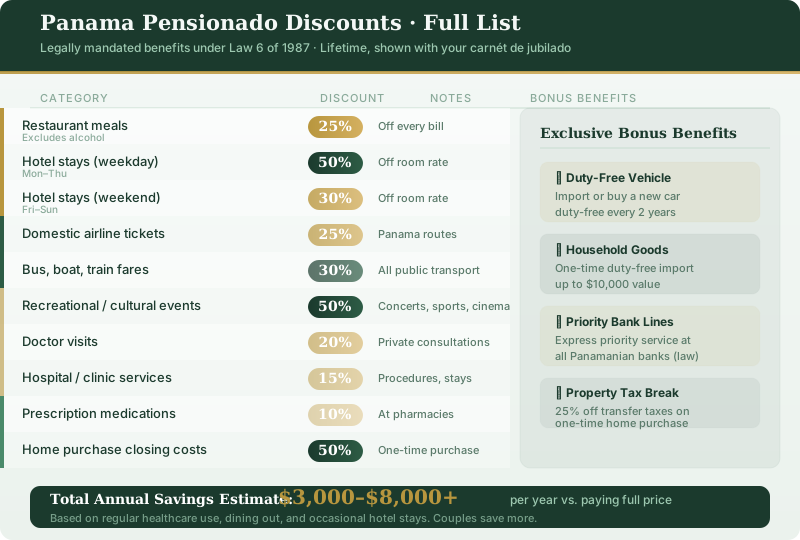
This is the section everyone wants. Most articles list the benefits vaguely (“discounts on healthcare and restaurants”). Here’s the actual list as mandated by Panamanian law.
| Category | Discount |
|---|---|
| Restaurant meals | 25% (excludes alcohol) |
| Hotel stays, weekdays (Mon–Thu) | 50% |
| Hotel stays, weekends | 30% |
| Domestic airline tickets | 25% |
| Bus, boat, and train fares | 30% |
| Recreational / cultural / sporting events | 50% |
| Movie theaters | 50% |
| Doctor visits | 20% |
| Hospital / clinic services | 15% |
| Dental and eye exams | 15% |
| Prescription medications | 10% |
| Property transfer taxes (one-time home purchase) | 25% |
| Closing costs on home purchase | 50% |
| Energy bill (up to 100kWh/month) | 25% |
Beyond discounts, the Pensionado program also gives you:
- One-time duty-free import of household goods up to $10,000
- Duty-free vehicle import every two years (or purchase a duty-free vehicle in Panama on the same cycle)
- Priority express lines at all Panamanian banks; required by law
Annual savings depend on how often you actually use the discounts. A single retiree in Panama City who uses healthcare regularly and eats out most days can realistically save $4,000–$7,000 per year compared to paying full price. A couple will save more. The hotel discount alone pays for a week in Boquete or on the coast a couple of times a year.
How to Apply: Step by Step
Step 1: Gather your documents (4–8 weeks)
This is the slow part, especially if you’re still in the US. Here’s what you need:
- Valid passport with at least 6 months remaining
- Official pension letter: this is the document most US applicants get wrong. From SSA, go to SSA.gov and request a Benefit Verification Letter (also called a Budget Letter). It must state your name, monthly benefit amount, and that the benefit is permanent. The document must then be apostilled at the state level. Each state has an apostille service; expect 1–3 weeks.
- National Police Certificate from your home country: a background check from the FBI (for US citizens), apostilled, dated within 3 months of submission. The FBI’s Identity History Summary Check takes 2–4 weeks; apostille adds another week.
- Medical certificate from a Panamanian doctor: a simple physical, done in Panama, ~$50–$100. Your lawyer can refer you to a clinic that handles immigration medicals.
- Proof of health insurance covering Panama (see Healthcare section below)
- 8 passport-sized photos
- Notarized copy of all passport pages
- Two personal reference letters from Panamanian citizens, long-term residents, or registered expats
All non-Spanish documents must be translated by a certified translator in Panama before submission.
Step 2: Hire a Panamanian immigration lawyer
Hire a lawyer. Not optional in practice. The DIY path technically exists, but apostille sequences, Spanish translation requirements, and document formatting rules mean that self-filed applications are frequently rejected for minor errors, and rejections reset the clock.
Lawyer fees: $800–$1,500, typically including coordination of the translation and government fees. Government filing fees run an additional $250–$350. Total all-in budget: $1,100–$1,850.
Ask your lawyer for an itemized quote and confirm whether government fees are included. Some firms quote the flat total; others add them separately.
Step 3: Submit the application
Your lawyer submits the application at the Migración offices on your behalf. You’ll need to be in Panama for the medical certificate and for the initial filing appointment, but you don’t have to stay for the duration.
Processing time: 3–6 months for initial provisional approval. Some cases take 6–8 months during heavy workload periods. Panama allows you to remain in country on tourist status (90 days, extendable) while your application processes.
Step 4: Provisional residency
Once your initial application is approved, you receive a provisional residency certificate. This is your legal status while the full file completes.
Step 5: Permanent residency + Pensionado card
Full permanent residency stamp goes in your passport. Your Pensionado card follows, typically 3–6 months after the provisional approval. Total timeline from document gathering to card in hand: 9–18 months depending on how quickly you can apostille and how busy Migración is.
Robert’s Timeline: A Real Example
Robert is 67, a retired public school teacher from Columbus, Ohio. His Social Security benefit is $1,800/month. He doesn’t own property in Panama.
Month 1: Requests Benefit Verification Letter from SSA.gov. Submits FBI background check request. Months 2–3: Receives apostilled SSA letter and FBI check. Flies to Panama for a two-week scouting trip, gets his medical certificate, meets with two immigration lawyers. Month 3: Hires a lawyer in Panama City for $1,200 (includes government fees). Documents submitted. Month 6: Provisional residency certificate issued. Robert books a three-month apartment in Boquete. Month 12: Full permanent residency confirmed. Pensionado card arrives. Robert’s hospital visits now cost 15% less, his meals out 25% less, his medications 10% less.
His lawyer’s fee was recovered in healthcare savings within the first year.
Pensionado vs. Friendly Nations Visa: Which Is Right for You?
| Pensionado Visa | Friendly Nations Visa | |
|---|---|---|
| Income required | $1,000/month pension | $2,000/month any passive income OR property/bank deposit |
| Income type | Pension (SS, military, company) only | Any passive: dividends, rentals, investments |
| Status granted | Permanent residency | Permanent residency |
| Processing time | 3–6 months | 3–6 months |
| Pensionado discounts | Yes, full list above | No |
| Best for | SS/pension retirees | Investors, rental income earners |
If your income is $1,800/month from Social Security: Pensionado. If your income is $2,500/month from stock dividends: Friendly Nations.
Some retirees have both pension and investment income. If the pension income alone clears $1,000/month, apply for Pensionado: the discounts are worth more than the Friendly Nations flexibility.
Where to Live in Panama as a Pensionado
Most Pensionado holders concentrate in a few places:
Boquete: The retirement capital of Panama. A mountain town at 3,900 feet elevation in Chiriquí province, with daytime highs of 68–75°F year-round. The expat community is one of the most established in Central America, with English-speaking services, expat clubs, and a reasonable cost of living. Furnished rentals run $700–$1,200/month for a comfortable apartment. Monthly Booking.com has good options for scouting trips before committing to a long-term lease. → Boquete, Panama Retirement Guide
Panama City: Better infrastructure, world-class private healthcare (Punta Pacífica Hospital is JCI-accredited and routinely handles complex cases), and genuinely affordable urban living by US standards. A two-bedroom in Miraflores or El Cangrejo runs $800–$1,400/month. The Pensionado discounts apply in full at the major hospitals and chains here. → Cost of Living in Panama City
Coronado: The Pacific beach corridor about 80 km southwest of the capital. Popular with retirees who want ocean access but don’t want to go as far as the islands. More North American infrastructure than Bocas.
Bocas del Toro: Caribbean islands, low cost, low infrastructure. Popular with a younger crowd and some retirees who specifically want island life. Healthcare access is limited; serious medical issues mean a flight to Panama City.
→ Best Places to Live in Panama
Healthcare for Pensionado Holders
Panama’s private healthcare system is the best in Central America. Punta Pacífica Hospital in Panama City (Johns Hopkins International affiliate) handles cardiac surgery, oncology, and complex cases at costs 40–60% below US prices; before your 15–20% Pensionado discount.
Important: US Medicare does not cover care outside the US. You need private health insurance from the moment you arrive.
For the Pensionado application, you must show proof of health insurance covering Panama. SafetyWing is an accepted option at around $47–$100/month depending on age, and it satisfies the immigration requirement. Once you’re established and know you’re staying long-term, Panamanian private insurers (Blue Cross Panama, MedAmerica) offer better long-term coverage at similar prices.
Money and Banking
Panama uses the US dollar, which eliminates the exchange rate problem most expats deal with in Latin America. Your Social Security arrives in dollars and you spend in dollars. No conversion needed.
For transferring money while you’re setting up accounts or before you have a Panamanian bank, Wise is the most cost-effective option; mid-market rate with a ~0.7% fee. Panama being dollar-denominated means this is mainly useful for people with non-US pension income who need to convert.
Panamanian banks (Banco Nacional, Banistmo, Global Bank) are straightforward to open with your Pensionado card. By law, every bank must give Pensionado card holders priority service lines.
Frequently Asked Questions
Can my spouse get Pensionado status? Yes. A dependent spouse can get residency under your application with an additional $250/month income shown (or none if they have no independent income). Dependent children also qualify. Your spouse gets a dependent residency card but not the full Pensionado card unless they independently qualify.
Do I have to live in Panama full-time? No minimum residency requirement by day count. The practical rule: if you’re absent from Panama for more than 24 consecutive months, your residency status can lapse. Return for a visit within that window to maintain it.
Can I work in Panama on a Pensionado Visa? No. The Pensionado Visa does not permit employment. Investment income and rental income are fine; active employment for a Panamanian employer requires a separate work authorization.
Is there a path to Panamanian citizenship? Yes. After 5 years of permanent residency, you can apply for naturalization and a Panamanian passport. Panama allows dual citizenship, so Americans don’t have to renounce US citizenship.
Are the discounts accepted everywhere? Major hotels, airlines, hospitals, and chain restaurants: reliably yes. Smaller family restaurants and local businesses: variable. Show your Pensionado card and ask; most places honor it even when they’re not required to.
Next Steps
If you have a lifetime pension of at least $1,000/month, the Pensionado Visa is straightforward. The income qualification is the main gate. Once you’re through it, the program rewards you with permanent residency and a set of benefits that genuinely improve day-to-day life in Panama.
Practical first steps:
- Verify your pension qualifies: call your SSA office or pension administrator and confirm the benefit is permanent and payable for life
- Request your Benefit Verification Letter from SSA.gov: this takes a few weeks and needs to be apostilled, so start now
- Book a scouting trip to Panama: 2–3 weeks in Boquete and Panama City is enough to know if you want to commit; Booking.com has furnished monthly-rate options in both places
- Consult two or three Panama immigration lawyers before committing to one; fee structures and communication styles vary significantly
- Plan the FBI background check: it runs on its own timeline and is often the slowest part of the document chain
For more on where to settle, see the Best Places to Live in Panama guide. If your income is investment-based rather than pension-based, the Friendly Nations Visa is likely your path instead.