
Opening a Bank Account in Panama as an Expat: The 2026 Guide
Panama uses the US dollar. For American expats, that’s a genuine advantage; no exchange rate risk, your wire transfers arrive in the same currency you spend, and your US card works everywhere from day one. What Panama does not offer is an easy path to a local bank account.
Panama’s banking system operates under some of the strictest Know Your Customer rules in Latin America. This is not an accident. Years of international regulatory pressure; from the FATF, the US Treasury, and the reputational fallout from the 2016 Panama Papers leak; pushed Panamanian banks toward documentation requirements that can feel extreme by comparison to opening an account in the US. Reference letters, apostilled documents, compliance reviews that take weeks: this is the reality.
It’s solvable. This guide walks through what’s required at each stage of residency, which banks work best for expats, and what to use while you wait.
The Central Rule: Residency Status Determines Your Options
Before anything else, you need to understand how your residency status affects what banks will and won’t do for you.
Three situations, very different outcomes:
1. Tourist / no residency in progress Most major banks will not open a standard account. Some will open limited accounts with higher minimum balances ($5,000+) and extra documentation, but you’ll be turned away at the door at most branches. A few smaller banks and some international institutions have non-resident account options; covered below.
2. Pending residency (application submitted, not yet approved) This is the in-between zone. Some banks will work with you if you have documentation showing your immigration process is underway: a letter from an immigration attorney, proof of application submission. Bring everything you have. It depends heavily on the branch and the compliance officer reviewing your file.
3. Residency granted (Pensionado, Friendly Nations, or other) Standard account opening is available at most major banks. You still need a full document package, and the compliance review takes weeks. But the answer is no longer “go away”; it’s “gather these documents and come back.”
Start your residency application as early as possible. Every month you delay is another month relying on bridge banking tools.
Why Panama Banking Is Strict: The Context That Matters
Panama has been used as an international financial center for decades, and not always for legitimate reasons. The 2016 Panama Papers: a massive leak of documents from law firm Mossack Fonseca; exposed how the country’s corporate and banking infrastructure was used to hide assets globally. The international backlash was significant.
Since then, Panama has repeatedly appeared on FATF (Financial Action Task Force) monitoring lists, faced US Treasury scrutiny, and overhauled its banking regulations. Panamanian banks now operate in an environment where a failed compliance review can trigger regulatory consequences. The result: they are conservative by default, documentation-intensive, and slow to approve foreign accounts.
This context matters because it explains why the rules exist and why they won’t change for you specifically. The best approach is to understand the requirements clearly, prepare thoroughly, and not take it personally when a bank asks for another document.
US citizens face an additional layer: banks require a completed W-9 form, and account activity is reported to the IRS under FATCA. This is standard and expected; bring a W-9 with you.
Which Banks Work Best for Expats
Banistmo: Best Overall Starting Point
Banistmo (now owned by Colombia’s Bancolombia Group) is the most commonly recommended bank by expats for accessibility and English-speaking service. It has specific experience with foreign account holders, branches in Panama City with bilingual staff, and a reputation for being the most workable option for Pensionado and Friendly Nations Visa holders.
- Minimum deposit: $500 for a savings account
- Account types: Savings (Cuenta de Ahorros), checking (Cuenta Corriente)
- Online banking: Available in English
- Best for: Pensionado holders, retirees, most expats with residency documentation
BAC International Bank: Best for Business and Professionals
BAC is a strong option for business-oriented expats and professionals. Its mobile banking app is well-regarded, and it handles international wire transfers reliably. It’s more actively targeted at residents than non-residents.
- Minimum deposit: ~$50 for savings accounts (lower barrier than Banistmo)
- Best for: Professionals, business owners, active international transactions
Global Bank: Worth Trying If Others Turn You Down
Global Bank is a Panamanian-owned institution that has developed specific experience with international customers. It’s often the suggestion from attorneys when a client has been declined elsewhere.
- More flexible on some documentation requirements in practice
- Less English-language capacity at branches; Spanish knowledge is helpful
- Good fallback option; verify current policies before visiting
Multibank: Another Non-Resident-Friendly Option
Multibank is known for being more accessible to international clients, including some non-residents with strong documentation. If you’re arriving without residency and need local banking, Multibank and Global Bank are the institutions worth exploring.
- Caters to international and business clients
- May work with well-documented non-residents
- Policies change; confirm directly before gathering documents
Scotiabank: Familiar for Canadians
Scotiabank’s Panama branch is a natural starting point for Canadian expats. The international brand recognition and familiar banking interface help. KYC requirements are similar to Banistmo. Conservative on non-residents.
What to Skip: Banco Nacional de Panamá
The state-owned national bank is not the right choice for most expats. It’s bureaucratic, language access is limited, and the account-opening process for foreigners is harder here than at private banks. Start elsewhere.
Document Checklist: What to Bring
This is the most practical part of this guide. Print this list and work through it before you visit any bank.
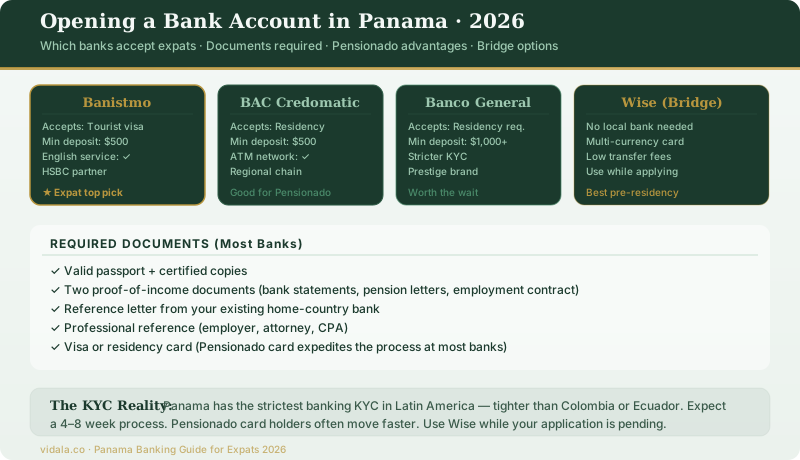
For residency holders (Pensionado, Friendly Nations, or other):
- Valid passport; original + notarized color copy
- Panama cédula (residency card), or proof of pending residency from immigration if awaiting cédula
- Proof of Panama address; utility bill or signed lease, under 90 days old; if not in your name, bring owner’s ID and a signed authorization letter
- Proof of income; pension award letter, employment contract, or 3–6 months of bank statements showing regular deposits; income amount should be clearly stated
- Bank reference letter from your home country bank; on bank letterhead, signed, within 30–90 days; some banks require two references
- Personal or professional reference letter; from a Panama-based attorney, accountant, or established business contact; some banks require this
- Source of funds documentation; increasingly standard; pension documents work for retirees; business owners may need corporate documents
- W-9 form (US citizens); bring a completed copy; the bank may have blank forms but having yours ready speeds the process
- Additional notarized copies; bring more than you think you need; some banks want three copies of everything
For Pensionado visa holders (simplified):
- Pensionado resolution document
- Proof of qualifying pension income (monthly amount, source)
- Passport + cédula
- Bank reference letter
- Proof of Panama address
The Pensionado process is genuinely easier. Banks see the pension documentation and understand exactly what they’re dealing with. If you qualify for the Pensionado visa, this is the most straightforward banking path available to you. See our Panama Pensionado Visa guide for eligibility details.
Apostille requirement: Some banks require that foreign documents; bank reference letters, income records, birth certificates; be apostilled. Ask your target bank explicitly before gathering documents. Getting an apostille after the fact adds delay; better to know upfront.
The Step-by-Step Process
-
Choose your bank. For most expats, start with Banistmo. If you have a specific reason to prefer BAC (lower minimum, business focus), start there.
-
Gather documents. Allow 2–4 weeks. Bank reference letters from US banks take time; some require a written request and 10–15 business days. Don’t leave this until you’re already in Panama.
-
Contact the branch before visiting. Call or email the Panama City branch to confirm current document requirements. Policies shift. Confirming in advance saves a wasted trip.
-
Visit in person. All major banks require in-person account opening. Panama City branches; particularly in the financial district (Punta Pacífica, El Cangrejo, Marbella); have the most experience with foreign account holders. A branch in Boquete or the interior will have less practice and may refer you to Panama City anyway.
-
Submit the application. You’ll meet with a personal banker who reviews your documents and submits a KYC application to the compliance team.
-
Wait for compliance review. This takes 2–6 weeks at most banks. The compliance team may come back with additional document requests. Respond promptly; delays here extend the process.
-
Account activation. Once approved, you’ll receive your debit card and online banking credentials. First transactions may have monitoring flags until the account history establishes itself.
Total timeline: 4–10 weeks from when you start gathering documents to an active account. Some expats report 2–3 weeks. Others take 3–4 months depending on the bank’s compliance backlog, document requests, and time of year. Plan for the longer end.
Bridge Banking: What to Use Before Your Account is Active
Panama is fully dollarized, which makes US-based tools work better here than in almost any other Latin American country. These two tools cover daily life without a local account.
Wise: Set This Up Before You Leave
Wise is the primary bridge banking recommendation for Panama-bound expats. Set it up before you leave the US: the account verification process takes a few days, and you want it ready before you land.
In Panama:
- USD balance works directly: no conversion needed; spend and receive in dollars
- Wise debit card works at ATMs across Panama (Banistmo, BAC, Citi ATMs throughout Panama City and major towns)
- Send money to local recipients: landlords, attorneys, contractors; at around 0.5% fee for USD-to-USD transfers
- Receive funds from your US bank at the same rate
This is the tool you’ll use for months while your local account application moves through compliance. Use it before, during, and even after; it stays useful for international transfers once you have a local account.
Charles Schwab High Yield Investor Checking: For ATM Access
Schwab’s checking account reimburses all ATM fees worldwide, with no cap, at the end of each month. ATMs in Panama typically charge $3–$5 for foreign cards. With Schwab, those fees disappear.
Apply from the US before you leave. No monthly fee, no minimum balance. Combine it with Wise and you have a complete banking setup that functions from day one.
Keep Your US Bank Account
Don’t close it. You need it for FBAR compliance, as the funding source for Wise and Schwab, and as a holding account for savings during the transition period. Some Panamanian banks also ask for a reference letter from your US bank; you can’t provide that if you’ve already closed the account.
ATMs in Panama
Panama City is well-covered: ATMs at Banistmo, BAC, Citi, and Scotiabank branches throughout Punta Pacífica, El Cangrejo, Marbella, and major shopping centers. Boquete has ATMs at the main banks in town; fewer options but sufficient for daily use. Interior towns and coastal areas: carry cash when you’re away from major centers; ATM coverage thins out.
Standard ATM fee for foreign cards: $3–$5 per withdrawal. Schwab reimburses. Select USD (not local currency) when prompted to avoid dynamic currency conversion charges.
Common Mistakes That Cost You Weeks
Showing up without residency documents. If your visa hasn’t been approved yet and you haven’t started the application, most banks will turn you away at the desk. Don’t make the trip until you have something to show.
Bringing unnotarized copies. Panama banks require notarized copies of your passport and supporting documents. Regular photocopies don’t work. Get your documents notarized at a US notary before you leave, or use a Panama-based notary (notario público) once you arrive.
Not requesting bank reference letters early enough. US banks are not fast about producing reference letters. Some require written requests. Some charge a fee. Some take two to three weeks. Start this process before you’re in Panama, not after.
Expecting a local account by end of week one. The compliance review is real and you cannot rush it. Build your Panama budget around bridge banking for the first 2–3 months, minimum.
Closing your US bank account before you leave. Keep it. You’ll need it as a funding source, for IRS requirements, and possibly as a reference source for your Panama bank application.
Frequently Asked Questions
Can a non-resident open a bank account in Panama? It’s possible but genuinely difficult. Multibank and Global Bank have the most reported flexibility for non-residents. Expect higher minimum deposits ($5,000 or more), more documentation, and a longer process. Residency changes the math dramatically; if you’re planning to stay, start the visa application first.
Do I need to speak Spanish? Not at Banistmo or BAC in Panama City; English-speaking staff are available at main branches. For other banks, bring a Spanish-speaking friend or hire an immigration attorney to accompany you. An attorney can also help navigate unexpected document requests.
Is my money safe in a Panamanian bank? The major banks; Banistmo, BAC, Scotiabank, Global Bank; are regulated by the Superintendency of Banks of Panama (SBP). The regulatory framework is legitimate. Panama does not have a government deposit guarantee equivalent to the US FDIC, so significant savings should be spread across accounts rather than concentrated in a single Panamanian institution.
Can I receive USD wire transfers from the US in my Panama account? Yes. USD is the local currency, so US bank wire transfers and ACH arrive normally. There are no conversion delays or currency complications.
How much do I need to keep in the account? Varies by bank: Banistmo requires around $500 minimum. BAC is closer to $50. Ask your target bank directly: these figures change. Once established, minimum balance requirements at most banks are low.
What’s the difference between Banistmo and BAC for most expats? Banistmo’s main advantage is English-language service and broader expat experience. BAC’s main advantage is the lower minimum deposit and strong mobile banking. Both are solid options. Try Banistmo first; if you hit barriers, BAC is the next stop.
Putting It Together
Panama’s banking system is not designed to welcome tourists. It’s designed to comply with international regulatory pressure while serving legitimate residents and businesses. Work with it, not against it.
The practical sequence:
- Set up Wise and get your Schwab card before you leave the US: these are your bridge banking tools for months
- Start your residency application early; the cédula is your key to local banking
- Request bank reference letters from your US bank before you move; they take longer than you expect
- Once in Panama, target Banistmo or BAC International as your first stop; contact the branch before visiting to confirm current requirements
- Plan for 4–10 weeks from document submission to active account
- If you have a Pensionado visa, your process will be faster and smoother; that visa was designed to make Panama accessible to retirees, and banks reflect that
For the full picture on what Panama costs and requires for a long-term move, see our Moving to Panama guide. If you’re retired, the Panama Pensionado Visa guide is the most relevant starting point; that visa changes both your residency options and your banking access in one step.