
Panama Friendly Nations Visa: The Complete 2026 Guide
Panama’s Friendly Nations Visa is the fastest legitimate path to permanent residency in Latin America for Americans, Canadians, Brits, and about 50 other nationalities. No minimum age. No pension income required. No requirement to live in Panama full-time.
The catch, and it’s an important one most guides gloss over; is that the rules changed significantly in 2021. The old “$5,000 bank deposit and you’re in” version is gone. Today you need to show economic ties to Panama, not just a bank balance. Understanding what that actually means, and which route fits your situation, is what this guide is for.
If you’re a citizen of an eligible country looking to establish legal residency in Panama in 2026, here’s everything you need to know before calling a lawyer.
What Is the Panama Friendly Nations Visa?
Visa Overview
The official name is Visa de Países Amigos; Friendly Nations Visa, or FNV for short. It was created by Executive Decree No. 343 in 2012 to attract citizens of countries that Panama has maintained “cordial and effective professional and commercial relationships” with.
The FNV grants permanent residency in Panama, not just a temporary work or stay permit. Specifically, you receive a cédula panameña (Panamanian ID card), which is permanent residency. You can work in Panama, own property, open bank accounts, and access most of what a Panamanian citizen accesses; except voting and a Panamanian passport.
The path to permanent residency has two stages now: first you get provisional residency (valid for two years), then; after demonstrating you’ve maintained your qualifying economic ties; you convert to permanent residency. Once you hold permanent residency for five years, you can apply for naturalization and eventually a Panamanian passport.
Who Qualifies: Eligible Countries
About 50 countries are on Panama’s list. The core of it:
Anglosphere: United States, Canada, United Kingdom, Australia, New Zealand
European Union/EEA: Germany, France, Spain, Portugal, Netherlands, Belgium, Austria, Sweden, Denmark, Finland, Norway, Switzerland, Ireland, Luxembourg, Italy, Greece, Poland, Czech Republic, Hungary, Slovakia, Estonia, Latvia, Lithuania, Croatia, Cyprus, Malta, Liechtenstein
Asia-Pacific: Japan, South Korea, Singapore, Hong Kong, Taiwan
Latin America: Argentina, Brazil, Chile, Uruguay, Costa Rica, Mexico, Paraguay
Other: Israel, Monaco, San Marino, Andorra, Montenegro, Serbia, South Africa
Most of Latin America beyond the countries listed above is not on the list; no Colombia, Peru, Bolivia, Venezuela, etc. Most of Africa, South Asia, and Southeast Asia (apart from the Asian countries listed) are also excluded.
If your country isn’t on the list, the Pensionado Visa or Investor Visa routes may be your options; they don’t carry the same nationality restrictions.
The 2021 Rule Change: Why It Matters
Before 2021: you deposited $5,000 in a Panamanian bank, filed some documents, and you were on your way to residency.
After 2021: you must demonstrate one of four categories of economic ties to Panama. The deposit option still exists, but the minimum jumped to $200,000. Here’s what the four options actually are:
- Employment in Panama: work for a Panamanian employer with a valid work permit
- Panama company ownership: form a Panamanian S.A. (corporation) and hire yourself (no $200K minimum; this is the most popular route for non-investors)
- Real estate investment: purchase property in Panama valued at $200,000 or more
- Fixed-term bank deposit: a certificado de depósito a plazo for $200,000 or more in a Panamanian bank, held for a minimum of three years
Most expats who aren’t already buying Panama real estate or parking $200K in a bank go the company formation route. It’s a legitimate holding company; it doesn’t need to be a real operating business with employees and revenues.
Requirements: Complete Document Checklist
This is where most guides fail you. Here’s the full list, including apostille requirements and translation needs.
Personal Documents (Everyone Needs These)
- Valid passport: original plus copy; must have at least 6 months of remaining validity
- Two passport-style photos: white background, front-facing
- Apostilled birth certificate: apostilled in your home country; certified Spanish translation required
- Apostilled police clearance certificate: from every country you’ve lived in for 2+ years in the past five years; not just your current country of residence
- Marriage certificate (if applicable): apostilled and certified Spanish translation
- Bank reference letter from your home bank: must be in Spanish (or accompanied by certified translation), confirm “good standing,” and note the length of your banking relationship; many US banks charge $25–$75 for this
- Medical certificate from a licensed Panamanian physician: you cannot use a doctor from your home country for this
Economic Ties Documents (Choose Your Route)
Route A: Company Ownership (Most Popular)
- Panama S.A. incorporation documents: your lawyer handles this
- Registration with the Registro Público de Panamá
- Proof that you are an officer or director of the company
- Employment contract between you and your company
- Work permit approval from Panama’s Ministry of Labor (MITRADEL)
- Notarized payroll or salary records showing you are being paid
Note: There is no minimum capital investment required for the company route, but the company must have a real economic purpose and you must actually be paying yourself a salary and remitting payroll taxes.
Route B: Real Estate
- Notarized property purchase agreement or registered deed
- Property registered in your name in the Registro Público
- Property must have a registered value of $200,000 or more
- Must be held for a minimum of three years
Route C: Fixed-Term Bank Deposit
- Certificado de depósito a plazo in a Panama bank regulated by the SBP (banking authority)
- Minimum $200,000, deposited in a single account
- Must be free of any liens or encumbrances
- Minimum three-year term
- Banks commonly used: Banco General, BAC Panama, Global Bank, Multibank
Route D: Employment with a Panamanian Company
- Employment contract with a Panamanian-registered employer
- Work permit approved by MITRADEL
- This route is less common because it requires finding a Panamanian employer willing to sponsor you
Application Fees (All Approximate: Verify at SNM Before Filing)
| Item | Estimated Cost |
|---|---|
| Government processing fee (SNM) | $250–$500 |
| Paz y Salvo (clearance certificate) | $15–$30 |
| Provisional residency ID card | $50–$100 |
| Police clearance apostille (per country) | $50–$200 |
| Birth certificate apostille | $50–$150 |
| Certified Spanish translations | $100–$300 total |
| Medical exam (Panamanian physician) | $50–$100 |
Step-by-Step Application Process
Step 1: Confirm Your Eligibility (1–2 Hours)
Verify your country is on the current friendly nations list. The official source is Panama’s Servicio Nacional de Migración (SNM), but the list is easiest to confirm through a Panamanian immigration lawyer, since the SNM site is not always current.
Choose your economic ties route. For most Americans and Europeans without $200K to park in a bank or spend on real estate, company formation is the starting point.
Step 2: Hire a Panamanian Immigration Lawyer (Strongly Recommended)
The FNV application is procedurally complex. The SNM is strict about documentation; wrong apostille jurisdiction, vague bank letter, incorrect form, and your application gets kicked back. Lawyers know the process and handle it for you.
Budget $1,500–$4,000 for full-service legal representation. Reputable firms used by expats include Morgan & Morgan, Galindo Arias & López, and Kraemer & Kraemer, but research current reviews, since firm quality can shift. Avoid any firm that promises “guaranteed approval” or suggests cutting corners on the economic ties requirement.
If you’re going the company route, your lawyer will likely handle incorporation simultaneously. This is efficient and common.
Step 3: Gather Apostilled Documents (2–8 Weeks)
This is the longest lead time in the process, particularly for Americans:
Police clearance (US citizens): You need an FBI Identity History Summary. The fastest legitimate option is using an FBI-approved channeler service; there are around 20 authorized channelers listed on the FBI website. Using a channeler costs roughly $18 (FBI fee) plus $50–$75 (channeler service fee) and takes 5–10 business days. Going direct to the FBI takes 10–12 weeks.
If you’ve lived in other countries for 2+ years in the past five years, you’ll need a police clearance from those countries too. Each country has its own process.
Birth certificate: Apostilled through the Secretary of State in the state where you were born, not where you currently live. Cost is typically $10–$30 for the apostille itself plus $15–$30 for the birth certificate copy if you need a new one.
Translations: Every non-Spanish document needs a certified Spanish translation. Your lawyer in Panama can often arrange this, or you can use certified translation services directly.
Step 4: Travel to Panama and Open a Bank Account (1–3 Days in Panama)
You need a Panamanian bank account regardless of your economic ties route. Banks do not open accounts remotely; you must appear in person.
Bring your passport, police clearance, proof of income or employment, and your bank reference letter. Processing takes 1–2 business days. Banks popular with expats: Banco General (largest, most branches), BAC Panama, Global Bank.
If you’re going the bank deposit route, make the $200,000 fixed-term deposit at this stage.
Step 5: Establish Economic Ties (1–4 Weeks, Depending on Route)
Company formation: Your lawyer registers the S.A. with the Registro Público, obtains a Paz y Salvo, and files for a work permit with MITRADEL. Work permit approval typically takes 2–4 weeks from submission. You need the work permit before filing your FNV application.
Real estate: You need the property registered in your name in the Registro Público. If you’re buying, your purchase timeline dictates this step; not something to rush.
Bank deposit: Already done in Step 4 if this is your route.
Step 6: File the Application with SNM
Your lawyer submits all documents at the SNM offices in Panama City. At the time of filing, the SNM issues a carné provisional (provisional ID card). This is important: it allows you to legally reside and work in Panama while your application is processed. You don’t need to wait for final approval to start your life there.
Step 7: Provisional Residency Resolution (3–6 Months)
After filing, the SNM issues a formal resolution granting provisional residency. Most recent reports from 2025–2026 suggest this takes 3–6 months from application date when documents are complete. Law firm marketing often says “as little as 6 months”, but incomplete applications cause delays, and SNM backlogs are real. Budget for 6 months and be pleased if it’s faster.
Your provisional residency is valid for two years.
Step 8: Permanent Residency (2 Years After Filing)
Before your provisional residency expires, you (through your lawyer) demonstrate that you’ve maintained your qualifying economic ties; company still active, real estate still owned, bank deposit still intact. SNM then converts your status to permanent residency and issues a permanent cédula panameña.
There is no minimum number of days you must be physically present in Panama to maintain provisional or permanent residency. You can travel freely.
Costs: What You’ll Actually Pay
This is the full picture, including costs most guides ignore.
Company Formation Route (Most Common)
| Item | Cost Range |
|---|---|
| Immigration lawyer (full service) | $1,500–$4,000 |
| Panama company formation | $800–$1,500 |
| Work permit filing | Included in lawyer fee or $200–$500 separately |
| SNM government processing fees | $250–$500 |
| Police clearance (FBI + apostille) | $100–$200 |
| Birth certificate apostille + translation | $100–$200 |
| Medical exam (Panamanian physician) | $50–$100 |
| Bank reference letter | $25–$75 |
| Translations (all documents) | $150–$400 |
| Panama bank account opening | $50–$200 |
| Flights to Panama (minimum 1 trip) | $300–$800 |
| Short-term accommodation during scouting trip | $100–$300/week |
| Total estimated out-of-pocket | $3,500–$8,500 |
Company operating costs going forward: annual legal/registered agent fee ~$200–$400/year, monthly payroll tax on salary you pay yourself.
Real Estate Route
| Item | Cost Range |
|---|---|
| Property purchase (minimum) | $200,000 |
| Immigration lawyer | $1,500–$3,000 |
| Property transfer taxes and fees (~5.6% of purchase price) | ~$11,000 |
| SNM government processing fees | $250–$500 |
| All document fees (same as above) | $500–$1,100 |
| Total estimated out-of-pocket | $213,000+ |
Bank Deposit Route
| Item | Cost Range |
|---|---|
| Fixed-term deposit (your money, locked 3 years) | $200,000 |
| Immigration lawyer | $1,500–$3,000 |
| Bank account and deposit setup | $50–$200 |
| All document fees (same as above) | $500–$1,100 |
| Total estimated out-of-pocket | $202,000+ |
The bank deposit route doesn’t lose the $200K; it’s your money, earning interest during the three-year term. But it’s illiquid for that period.
FNV vs. Pensionado Visa: Which Is Right for You?
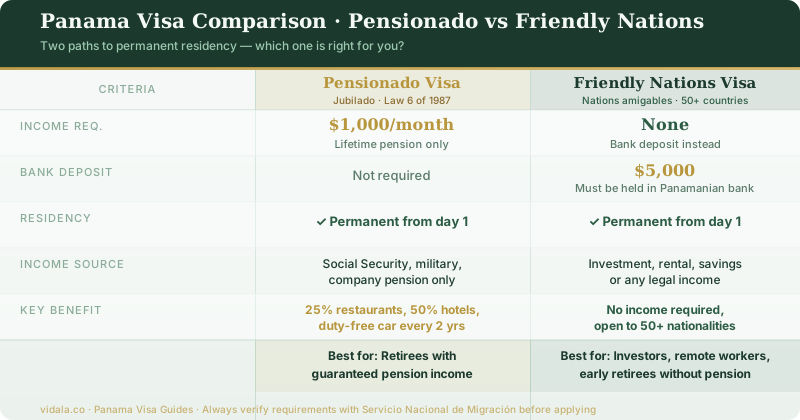
Panama offers two primary residency routes for foreigners. Here’s the honest comparison:
| Friendly Nations Visa | Pensionado Visa | |
|---|---|---|
| Nationality requirement | 50 eligible countries only | Any nationality |
| Income requirement | None (economic ties instead) | $1,000/month verifiable pension |
| Investment required | Yes (company, real estate, or $200K deposit) | None |
| Age requirement | None | None |
| Discounts | None | 20–50% off healthcare, utilities, entertainment, hotels |
| Time to provisional residency card | Days (card issued at filing) | Days |
| Time to permanent residency | 2 years after filing | 2 years after filing |
| Best for | Non-retirees; entrepreneurs; anyone without qualifying pension | Retirees with Social Security or pension income ≥ $1,000/month |
If you’re 60+ with U.S. Social Security income of $1,000/month or more, the Pensionado Visa is the better deal. The discounts (25% off airline tickets, 50% off hotel stays during weekdays, 20% off medical consultations, 15% off hospital bills) add up fast in retirement. The FNV offers none of these.
If you’re younger, working remotely, or don’t have a qualifying pension, FNV is your path; particularly the company formation route.
One more factor: the Pensionado Visa is open to any nationality. If your country isn’t on the friendly nations list, Pensionado may be your best Panama option.
Living in Panama After Residency
Once you have provisional residency in hand (which happens the same week you file), you can start building your life in Panama. A few things to know:
Where most FNV holders settle: Panama City’s El Cangrejo neighborhood is a popular base for new expats; walkable, full of restaurants and cafes, with monthly furnished apartment rents running $800–$1,500/month. Punta Pacífica and San Francisco are more upscale at $1,500–$3,000/month. Boquete, a mountain town four hours from Panama City, attracts retirees with a slower pace and average temperatures of 65–75°F year-round.
Working in Panama: With the company formation route, you work for your own company; that’s the qualifying economic tie. You can also seek employment with a Panamanian company, but you’d need an additional work permit for that employer separate from your FNV company.
Taxes: Panama uses a territorial tax system. Income earned inside Panama is taxable. Income earned outside Panama; foreign-source income; is not taxed in Panama. For remote workers earning in USD from foreign clients, this can be significant. That said, your home country’s tax rules still apply (US citizens are taxed on worldwide income regardless of residency). Consult a cross-border tax professional before making decisions based on Panama’s tax structure.
Healthcare: Panama has a solid private healthcare system. Consultations in Panama City run $50–$100, specialist visits $80–$150. Until you’re enrolled in Panama’s CSS (social security) system or have private expat health insurance, SafetyWing covers Panama at around $47–$80/month depending on age; useful as a bridge during the application period.
Sending money: Transferring funds to your Panamanian bank account costs least through Wise; typically 0.4–0.8% vs. 3–5% at traditional banks for USD transfers to Banco General or BAC Panama.
Short-term stays: If you’re doing a scouting trip or a temporary base while the residency processes, Booking.com lists furnished monthly rentals in El Cangrejo and Boquete with flexible cancellation, which is more practical than committing to a lease before you know where you want to land.
For a deeper look at Panama’s neighborhoods, costs, and lifestyle: Best places to live in Panama.
Common Mistakes That Get Applications Rejected
These aren’t edge cases; they’re the most frequent reasons applications get kicked back or delayed by months.
1. Apostille from the wrong jurisdiction
An apostille must come from the government authority in the country that issued the document. A US birth certificate must be apostilled by the Secretary of State in the state that issued it, not the US State Department, not a notary. Getting this wrong means obtaining and re-apostilling the correct documents.
2. Police clearance that doesn’t cover every required country
You need police clearance from every country where you’ve lived for two or more continuous years in the past five years. If you lived in Germany for two years and the UK for three, you need clearance from both, not just your current home country. Applicants frequently submit only FBI clearance and miss prior countries.
3. Bank reference letter too vague
The letter must specifically state “good standing” and include the duration of your banking relationship. A generic confirmation that an account exists doesn’t satisfy SNM. Many US banks produce these on request, but they default to a minimal format; request a detailed version and verify it includes standing and relationship length.
4. Company formed without proper work permit
The company formation route requires an approved work permit (permiso de trabajo) from MITRADEL before the FNV application is filed. Some applicants form the company thinking that alone qualifies them, then discover the work permit adds weeks to the timeline.
5. Medical certificate from a non-Panamanian physician
The medical certificate must come from a licensed physician in Panama. You can get the physical done before your trip, but the paperwork must be signed by a Panamanian doctor. This requires at least one in-person trip to Panama; there’s no way around it.
6. Missing certified Spanish translations
Every document that isn’t originally in Spanish needs a certified Spanish translation. This applies to birth certificates, police clearance letters, bank reference letters, and any foreign court documents. Non-certified (Google Translate, uncertified translation service) documents are rejected.
Frequently Asked Questions
Can I work in Panama on the FNV?
Through your own Panamanian company; yes. The company formation route explicitly involves paying yourself a salary from a Panamanian entity, which is legal. Working for a separate Panamanian employer requires an additional work permit from MITRADEL.
Do I need to live in Panama full-time?
No. There’s no minimum physical presence requirement to maintain FNV provisional or permanent residency. You can spend most of your time outside Panama. This makes it appealing for people who want residency options without committing to relocation.
Can my spouse and children be included?
Yes. Dependents; spouse and unmarried children under 18 (or up to 25 if enrolled full-time in university); can be included in the same application. Each dependent needs their own set of documents (passport, police clearance, etc.). Additional government fees apply per dependent.
Does FNV lead to Panamanian citizenship?
After five years of permanent residency, you may apply for naturalization. The citizenship application requires demonstrated ties to Panama and is discretionary; it’s not automatic. Consult an immigration lawyer if citizenship is the long-term goal.
What happens if I can’t maintain my economic ties?
If your qualifying company is dissolved, property is sold, or bank deposit withdrawn before the permanent residency stage, your provisional residency status is at risk. This is a real concern for the bank deposit route (illiquid for three years) and the company route (requires annual maintenance).
Is the FNV still worth it after the 2021 changes?
For non-retirees; yes, especially the company route. Forming a Panama S.A. and hiring yourself is a legitimate, affordable path to permanent residency in a country with territorial taxation, no minimum stay requirement, and one of the best banking infrastructures in Latin America. The old “$5,000 deposit” version was arguably too easy; the current requirements weed out applicants who aren’t serious about Panama ties.
How long before I can apply for a Panamanian passport?
At minimum: 2 years to permanent residency + 5 years of permanent residency + naturalization processing time = roughly 8–10 years from initial application before a passport is realistic.
Concrete Next Steps
If Panama is the move, here’s the order of operations:
-
Confirm your country is eligible: check the current SNM list or ask a Panamanian immigration lawyer for confirmation (most offer free initial consultations)
-
Choose your route: company formation if you want the lowest capital requirement; real estate or bank deposit if you’re already planning those investments
-
Start the apostille process immediately: this is always the longest step; the FBI Channeler service for US citizens takes 1–2 weeks, not months, if you use an authorized channeler
-
Hire a Panamanian immigration lawyer: budget $1,500–$4,000; get references from expat forums (Expats in Panama Facebook group is active) before committing
-
Book your Panama scouting trip: you need to appear in person to open a bank account; combine that trip with neighborhood research so you know where you want to base yourself
The FNV is genuinely one of the most accessible legal permanent residency options in Latin America for qualifying nationals. The 2021 rule change raised the bar, but it didn’t close the door. For most people in eligible countries, the company formation route makes this achievable at under $10,000 in out-of-pocket costs, for legal permanent residency in a stable, dollarized country with a territorial tax system.
That’s a reasonable deal.