
Healthcare in Panama for Expats: Insurance, Costs & Pensionado Discounts (2026)
Hospital Punta Pacífica in Panama City is the only Johns Hopkins–affiliated hospital in Latin America. It’s been JCI-accredited since 2011, earned its fifth reaccreditation in 2023, and Johns Hopkins Medicine International conducts week-long on-site audits every year. This is not a cosmetic affiliation. It’s the reason Panama City healthcare sits in a different category than most of Central America.
That said, Panama’s healthcare picture is more complicated than “great hospital, done.” Panama City’s private hospitals are genuinely excellent. Boquete has adequate clinics and decent facilities 45 minutes away in David. Beach towns and the interior are a different story. And while Panama is cheaper than the US, it costs more than Ecuador or Colombia. The USD economy means hospital infrastructure is priced accordingly.
There’s also the Pensionado question. Every guide mentions that Panama’s Pensionado visa comes with medical discounts. None of them explain how those discounts actually work at the hospital registration desk, whether they stack with insurance, or when cash-pay with Pensionado discounts is a realistic strategy versus when it isn’t.
For the full picture on visas, neighborhoods, and cost of living, see Moving to Panama: Complete Guide.
How Good Is Healthcare in Panama? Honest Assessment
Private Hospitals in Panama City (The Real Picture)
Panama City’s private hospital sector is legitimately good. Hospital Punta Pacífica (now operating as Pacífica Salud) is the anchor: Johns Hopkins–affiliated, JCI-accredited five times over, and the facility where wealthy Panamanians and medical tourists go for complex procedures. English-speaking staff are available. Specialists with US and European training are common. The facility feels more like a US private hospital than anything else in the region.
Hospital Nacional is the second major private option, also well-regarded, with broad specialist coverage and a strong reputation for cardiology and orthopedics. Centro Médico Paitilla rounds out the top tier. All three are private-pay (or insurance), and all three accept international insurance plans without the friction you’d encounter at public facilities.
The honest caveat: Panama’s private hospitals are good at the things you actually need. They’re not academic research centers. For extremely complex subspecialty care (advanced cancer protocols, experimental treatments, very rare conditions) you’d still consider returning to the US. But for the full range of what retirees and expats realistically deal with: excellent.
The CSS Public System: Who Can Use It?
The Caja de Seguro Social (CSS) is Panama’s public insurance and healthcare system. Panamanians who work formally are enrolled automatically. Expats can access it through voluntary enrollment.
The voluntary enrollment process requires a sworn statement of income ($500/month minimum declared), proof of residency, and a medical examination. Medical exams cost $94 for foreigners versus $47 for Panamanians. The process can be completed online or in person at a CSS administrative office.
The practical reality: CSS provides coverage but access is through CSS facilities, not the private hospitals listed above. Wait times for non-urgent specialist care are long. The quality gap between CSS facilities and Panama City’s top private hospitals is real. Most long-term expat residents use CSS as a backup or supplement, not a primary care option. If you’re planning to rely on CSS as your main healthcare, spend some time in a CSS clinic before committing to that plan.
Healthcare Outside Panama City
This is where the honest picture gets harder.
Boquete has smaller clinics that handle basic care, and a Policinica equipped for emergencies. But for anything beyond routine care, you’re heading to David, a 30–45 minute drive. In David, Hospital Chiriquí and Mae Lewis Hospital are your options. Both are private, both are adequate, and the standard of care is reasonable for common conditions. Complex or serious cases get transferred to Panama City.
Beach towns (Coronado, Pedasi, Bocas del Toro) have clinics that can handle minor issues and stabilize emergencies. Anything serious: you go to Panama City.
If you’re deciding between Boquete and Panama City and healthcare is a priority, the difference is real. You’re not making a catastrophic trade-off by living in Boquete, but you are accepting that serious care means travel. For someone who requires regular specialist management of a complex condition, Panama City makes more sense.
What Does Healthcare Cost in Panama?
Panama’s healthcare costs less than the US, a lot less, but more than Ecuador or Colombia. The USD economy and the US-aligned infrastructure at top hospitals means the pricing reflects that positioning.
| Service | Panama Private (cash) | With Pensionado Discount | US Cost |
|---|---|---|---|
| GP visit | $60–$100 | $48–$80 | $150–$300 |
| Specialist | $80–$150 | $64–$120 | $200–$500 |
| ER visit | $150–$300 | $128–$255 | $1,500–$3,000 |
| MRI (standard) | $500–$600 | $425–$510 | $1,500–$3,000 |
| Day surgery | $3,000–$10,000 | $2,550–$8,500 | $15,000–$40,000 |
| Hospitalization (per night) | $300–$600 | $255–$510 | $2,000–$5,000 |
Prices reflect 2025–2026 private facility rates in Panama City. Boquete/David facilities run somewhat lower.
The MRI comparison is illustrative. A standard MRI at a Panama City private facility runs $500–$600. At a facility in David, it’s lower. In the US without insurance, the same scan is $1,500–$3,000. Even before Pensionado discounts, the math is favorable for most procedures.
Prescription medications run 40–60% cheaper than US retail. Common generics cost $3–$10 at Farmacias Arrocha or Super 99 pharmacy locations, which are the most reliable chains for stock and quality. Specialty medications are generally available in Panama City; less reliably so in Boquete or smaller towns.
The Pensionado Discount System: What It Actually Covers
Panama’s Pensionado visa comes with legally mandated discounts at medical facilities nationwide:
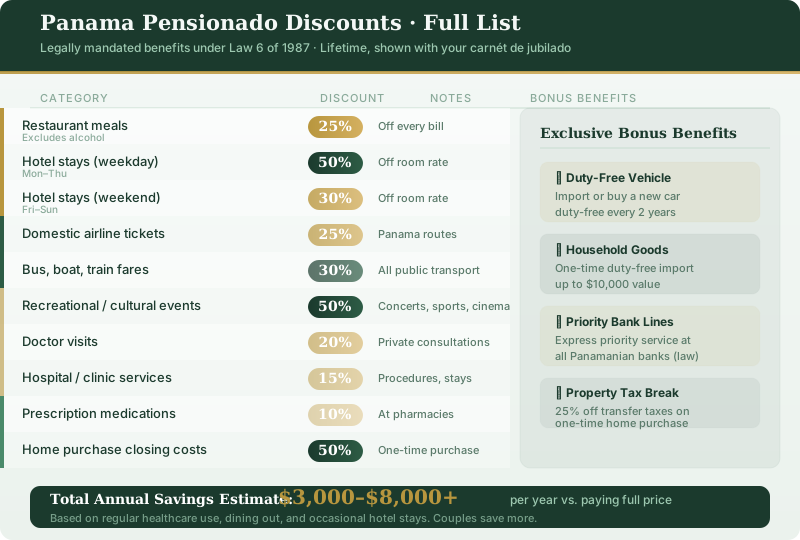
- 20% off doctor’s consultation fees
- 15% off hospital bills (when no insurance applies)
- 10% off prescription medications
How to Actually Use It at a Hospital
When you arrive at a private hospital or clinic, you present your Pensionado carnet (your residency card showing Pensionado status) at registration. The discount is applied to the base bill at the point of service. You don’t apply for it after the fact. You don’t file paperwork. You show your card, they note it in the system, and your bill reflects the discount.
The discount applies to the hospital’s or doctor’s base fee. It is calculated before insurance is applied.
Do You Still Need Insurance If You Have Pensionado Discounts?
Yes. And the explanation matters.
The Pensionado discount reduces your out-of-pocket cash costs: 20% off a $100 doctor visit brings you to $80. That’s useful for routine care, and over time it adds up. But the discount does not replace insurance for what it’s actually there to cover: catastrophic events.
A major surgery in a Panama City private hospital runs $10,000–$40,000. With a 15% Pensionado discount, that’s $8,500–$34,000. Still a bill that most people cannot absorb from savings without financial damage. Emergency evacuation to the US without coverage costs $30,000–$80,000. Pensionado discounts don’t touch that.
The realistic picture: Pensionado discounts make cash-pay viable for routine care (annual checkups, specialist consultations, minor procedures). They do not make it viable for hospitalizations, surgeries, or emergencies. If you’re planning to live in Panama without insurance on the logic that you have Pensionado discounts, you’re underinsured for the risks that actually matter.
Some expats in their 50s with large liquid emergency funds ($75,000+) self-pay for routine care using the Pensionado discount and carry a high-deductible international plan for catastrophic coverage. That’s a defensible strategy. Pure self-pay with discounts is not.
Your Insurance Options: Which Is Right for You?
CSS (Caja de Seguro Social): Voluntary Enrollment
Available to expats with legal residency. Monthly contributions are calculated based on declared income. At the minimum base of $500/month, you’re paying roughly $85–$100/month. Coverage is broad on paper: doctor visits, hospitalization, surgeries, medications.
The catch is access. You use CSS facilities, not the private hospitals. Wait times for non-urgent specialist care can stretch weeks. For expats who are healthy, comfortable navigating the system with some Spanish, and primarily want catastrophic cost protection, CSS is a real option. For those who want private hospital access and shorter waits, it’s a supplement at best.
Best for: Long-term permanent residents on a tight budget who are primarily concerned with catastrophic coverage.
Local Private Insurance (ASSA, Mapfre)
ASSA Seguros and Mapfre both offer local private health insurance in Panama. Coverage is for Panama private hospitals, including the top ones, without the wait times or access restrictions of CSS.
Monthly costs run $80–$150 for a healthy adult under 55. Pre-existing conditions are typically excluded or heavily surcharged. No international coverage. Claims are handled locally, which is convenient when you live in Panama and not convenient if you ever need care elsewhere.
Best for: Permanent residents under 55 who are primarily planning to stay in Panama and want private hospital access at lower premiums than international plans.
Pacific Cross: The Expat Favorite
Pacific Cross is the most commonly cited insurer among Panama expats, and the recommendation comes up repeatedly in Facebook groups and expat community forums because it has earned it. Plans cover inpatient and outpatient care at Panama’s top private hospitals, with optional dental and vision add-ons.
The Essential plan starts around $100–$150/month for a healthy 35-year-old and covers Panama and Central America. The Comprehensive plan runs $180–$350/month and adds broader international coverage including the US for emergencies. Age limit is 74 for initial enrollment on most plans.
Pacific Cross satisfies the Friendly Nations Visa insurance requirement. The claims process is in English and the customer service is accustomed to dealing with expats. For the majority of people who want regional coverage at reasonable premiums, this is the right starting point.
Best for: Expats under 65 planning to live primarily in Panama and Central America.
International Plans (Cigna Global, BUPA, AXA/APRIL)
International plans give you coverage in Panama, when you travel internationally, and optional US emergency coverage. For retirees who still visit the US regularly or who want the flexibility of being covered wherever they are, an international plan makes sense.
Cigna Global is a strong option for Panama retirees: solid Latin America coverage, English support, efficient claims, and optional US emergency coverage you can add to most plans. A 60-year-old can expect to pay $250–$350/month for mid-tier coverage. Cigna satisfies visa insurance requirements.
BUPA International covers up to age 80 for initial enrollment, which is relevant for older retirees that Pacific Cross won’t take. Premiums are higher ($300–$500/month for a 65-year-old) but the coverage is genuinely broad.
APRIL International is the budget international option, covering up to age 75. Plans start lower than Cigna or BUPA and work well for relatively healthy expats who primarily want catastrophic coverage with international flexibility.
SafetyWing at approximately $47/month is the ultra-budget option for expats under 40. It’s primarily travel medical and nomad insurance with emergency and evacuation coverage. It works for digital nomads on shorter stays, for expats who already have local insurance and want supplementary international coverage, or for your scouting trip before you set up a full plan. Not the right primary insurance for a retiree with ongoing health needs, but excellent value for emergency-only coverage.
Best for: Expats who travel internationally or to the US regularly, older retirees who need US coverage options, and anyone who values the flexibility of global coverage.
International Plans vs. Pacific Cross: The Comparison
| CSS (Voluntary) | Local Private (ASSA) | Pacific Cross | International (Cigna/BUPA) | |
|---|---|---|---|---|
| Monthly cost | ~$85–$100 | $80–$150 | $100–$350 | $150–$500+ |
| Hospital access | CSS facilities | Panama private | Panama + Central America | Worldwide |
| International coverage | No | No | Limited | Yes |
| US emergency coverage | No | No | No (standard) | Optional |
| Age limit for enrollment | None | ~65 | 74 | 74–80 |
| Satisfies visa requirement | Check with attorney | Usually | Yes | Yes |
| Pre-existing conditions | After waiting period | Usually excluded | Usually excluded | Usually excluded |
The practical path for most arriving expats: start with Pacific Cross or Cigna Global for your first year. You get immediate private hospital access, visa compliance, and time to understand the system. After a year on the ground, reassess whether CSS voluntary enrollment makes sense as a complement.
Which Insurance Does Your Panama Visa Require?
| Visa Type | Insurance Required? | Recommended Approach | Notes |
|---|---|---|---|
| Tourist (up to 180 days) | No, but recommended | International travel plan | Cash-pay works at private hospitals |
| Friendly Nations Visa | Yes — required at application | Pacific Cross or international | Must show active policy at submission |
| Pensionado Visa | No (legally), but yes (practically) | Pacific Cross or local private | Discounts reduce cash costs but don’t replace catastrophic coverage |
| Professional / Investor | Often CSS via employer | CSS + optional top-up | Confirm with employer or immigration attorney |
| Permanent Resident (E-category) | No | Pacific Cross or international | Same practical situation as Pensionado |
The Friendly Nations Visa requires health insurance at the time of application, not just a plan to get insurance eventually. If you’re in the process, get your Pacific Cross or Cigna policy in place before submitting your application documents.
The Pensionado Visa has no legal insurance requirement, which surprises people. But see the Pensionado discount section above for why you still need it.
Best Hospitals in Panama for Expats
Panama City
Pacífica Salud (Hospital Punta Pacífica): The top choice for expats and medical tourists. Johns Hopkins affiliated, JCI-accredited, English-speaking staff available, and the facility where you want to be for anything serious. Costa del Este campus also received JCI accreditation in 2023.
Hospital Nacional: Strong across most specialties, particularly cardiology and orthopedics. A genuine second option if you can’t get a timely appointment at Pacífica Salud or want a second opinion.
Centro Médico Paitilla: Solid third option, well-established in Panama City’s private medical community. Good for routine specialist visits.
All three are in Panama City’s core urban area. They accept major international insurance plans and have experience with expat patients.
Boquete and Chiriquí Province
Boquete has a Policinica that handles emergencies and basic care. For anything beyond that, David is the destination, 30–45 minutes away depending on where in Boquete you’re staying.
In David, Hospital Chiriquí and Mae Lewis Hospital are both private facilities that handle most common conditions adequately. Both have improved over the years partly due to the region’s growing expat population. Serious or complex cases get referred to Panama City.
The Boquete expat community is active and will give you specific doctor recommendations for the David facilities. Ask in the Boquete Facebook groups for current referrals.
Beach Towns and the Interior
Coronado and the Azuero peninsula have clinics. Bocas del Toro has limited facilities. The rule of thumb: for anything beyond basic care, you’re going to Panama City or, in Chiriquí, to David. Plan accordingly when choosing where to live.
How to Access Care: Practical Steps
Setting up insurance: Apply for Pacific Cross or your international plan before arriving or immediately after. Don’t wait until you need care to figure out your coverage.
Enrolling in CSS: If you have legal residency and want voluntary CSS coverage, bring your residency certificate, cedula, sworn income statement, and $94 (the foreigner medical exam fee) to a CSS administrative office or use the online system. The process takes a few hours and is doable without a lawyer if you have some Spanish.
Using your Pensionado card at hospitals: Present your Pensionado carnet at registration, not at checkout. Staff are accustomed to this. Pensionado discounts are routine at Panama City private hospitals. If the registration desk doesn’t note it immediately, ask explicitly before they generate your bill.
In an emergency: Go to the private hospital ER. Pacífica Salud, Hospital Nacional, or Paitilla in Panama City. Private ERs are faster and better equipped than public options. Entry and initial assessment run $100–$300. Have your insurance card or policy number accessible; the faster you can show coverage, the smoother the process.
Medical evacuation: Confirm your insurance plan includes medical evacuation before you buy it. Evacuation to the US from Panama without coverage can run $30,000–$80,000. Most international plans and Pacific Cross Comprehensive include this; verify the sub-limits and conditions before assuming you’re covered.
Frequently Asked Questions
Can I use Medicare in Panama? No. Medicare does not cover international care. This catches some American retirees off guard. Medicare is US-only, full stop. You need private insurance.
What if I have a pre-existing condition? CSS covers pre-existing conditions after a waiting period, which makes it uniquely attractive for long-term residents with existing health issues. Pacific Cross and local private insurers typically exclude pre-existing conditions or charge significant surcharges. International plans vary: some offer modified coverage with pre-existing conditions, most require full disclosure at application.
Is Panama City healthcare good enough for major surgery? At Pacífica Salud and Hospital Nacional, yes, for the majority of common major procedures. Complex cardiac surgery, oncology requiring experimental protocols, or very specific subspecialty needs may warrant returning to the US. But hip replacements, orthopedic procedures, general surgery, cardiac stenting: Panama City’s top private hospitals handle these routinely.
How do Pensionado discounts work if I also have insurance? The discount applies to the base bill before insurance is applied. In practice, if your insurance covers the bill, the Pensionado discount doesn’t reduce your out-of-pocket further. The insurer pays the discounted bill. The discount is most useful for cash-pay visits where you’re paying directly: consultations, routine tests, prescription medications.
Is English spoken at Panama City private hospitals? At Pacífica Salud, yes. They have English-speaking staff specifically for international patients. At Hospital Nacional and Paitilla, English competency varies by staff member. In David and Boquete clinics, Spanish is the working language. Download Google Translate if your Spanish is limited; it handles medical vocabulary well enough for most situations.
The Practical Path Forward
Panama’s healthcare is a genuine advantage: better than most of Central America at the top end, and priced well below the US even before Pensionado discounts.
The healthcare decision comes down to where you’re living and what you need:
- Arriving in Panama City: Get Pacific Cross Essential or Cigna Global — satisfies your Friendly Nations or visa requirement, gives you immediate access to Pacífica Salud and Hospital Nacional
- Pensionado visa holders: Get private insurance anyway — use the 20% discount on cash-pay routine visits and GP consultations, let your insurance handle hospitalizations
- Boquete or Chiriquí: Same insurance logic applies; also find a doctor in David before you need one
- After settling with permanent residency: Evaluate CSS voluntary enrollment as a complement if budget matters and you’re in good health
Get a quote from Pacific Cross if you’re staying in the region, or Cigna Global if you travel internationally often or want the US emergency option. Both are legitimate and both work in Panama. The comparison is mostly about how much international flexibility you want and what you’re willing to pay for it.
For a full comparison of healthcare across Ecuador, Colombia, and Panama, see our Ecuador Healthcare Guide and Colombia Healthcare Guide. Panama costs more than both, but Panama City’s quality at the top end is also higher.
Prices and insurance costs as of early 2026. Verify current premiums directly with insurers and confirm visa insurance requirements with your immigration attorney before applying.