
Colombia Retirement Visa (Pensionado/Rentista): The 2026 Application Guide
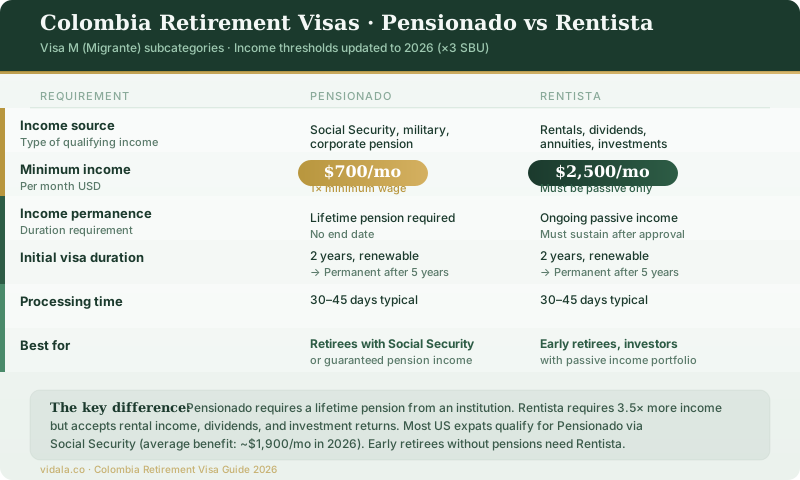
Colombia offers two retirement visa paths, and they’re not interchangeable. The Pensionado visa is for people with a lifetime pension (Social Security, corporate pension, military retirement). The Rentista visa is for people living off investment and passive income; rentals, dividends, annuities. Most guides treat them as variations of the same thing. They’re not. The income thresholds differ by more than three times, and the documentation requirements are entirely different.
This guide covers both clearly: who qualifies, the exact 2026 income figures, what documents you need, and the step-by-step application process. If you’re comparing Colombia with Panama before deciding where to retire, there’s a head-to-head comparison table toward the end.
Quick reference: Colombia updated its minimum wage in January 2026 (a 23% increase), which affects both thresholds. Any guide that cites older figures is out of date.
Colombia’s Two Retirement Visa Types: Overview
Both visas fall under the Visa Tipo M (Migrante) category, governed by Resolución 5477/2022. Here’s how they compare:
| Visa M, Pensionado | Visa M, Rentista | |
|---|---|---|
| Income type | Lifetime pension (SS, corporate, military) | Passive income (rental, dividends, annuities) |
| 2026 income threshold | 3× SMMLV, ~$1,410/month | 10× SMMLV, ~$4,600/month |
| Income must be “permanent”? | Yes, pension must be lifetime | No, but must be demonstrably stable |
| Visa duration | Up to 3 years, renewable | Up to 3 years, renewable |
| Work permitted? | No | No |
| Path to permanent residency? | Yes (after 5 qualifying years) | Yes (after 5 qualifying years) |
The Rentista threshold is the surprise for most people. Colombia’s 2026 SMMLV (salario mínimo mensual legal vigente) is COP 1,750,905, set by Decree in December 2025. Three times that equals COP 5,252,715 per month ($1,410 USD). Ten times that equals COP 17,509,050 per month ($4,600 USD). If you’re living off a stock portfolio or rental income, that’s the bar you need to clear.
Pensionado Visa: For Retirees with Pension Income
Who Qualifies
You qualify if you receive a lifetime pension from any government, private, or international pension fund, and that pension exceeds 3× Colombia’s minimum wage per month. U.S. Social Security qualifies. A corporate pension from your former employer qualifies. Military retirement income qualifies. There’s no minimum age requirement; if you receive a qualifying lifetime pension, you can apply regardless of age.
The pension must be monthly, lifetime, and payable regardless of where you live. One-time payouts, lump-sum distributions, or defined-benefit payouts that expire don’t count.
Required Documents
- Valid passport: 6+ months remaining validity beyond your intended visa end date
- Pension certification letter: from SSA, your pension administrator, or your employer’s pension fund. The letter must state: your name, monthly benefit amount, that the pension is permanent/lifetime, and that it’s payable internationally. Format doesn’t need to be fancy; it just needs those four elements.
- National background check from your home country: apostilled, issued within 3 months of your application
- Health insurance covering the full visa period in Colombia; see the SafetyWing note below
- Photos: 3×4 cm, white background, recent
Fees: $54 USD application fee (estudio) + $270 USD issuance fee upon approval = $324 total
Getting Your SSA Benefit Verification Letter (US Applicants)
The fastest method: log into your my Social Security account at ssa.gov/manage-benefits/get-benefit-letter. You can generate and download the PDF immediately; no waiting. The letter shows your monthly benefit amount and confirms it’s a lifetime benefit.
Once you have the letter, you need to get it apostilled. For U.S. federal documents (which SSA letters are), the apostille comes from the U.S. Department of State Office of Authentications: not your state’s Secretary of State. Mail the original letter with Form DS-4194 and $20/document. By mail: budget 4–6 weeks. Using a D.C.-based professional service: 2–3 weeks.
FBI Background Check: Start This First
This is where most U.S. applicants miscalculate their timeline. The process has two parts:
-
Request your Identity History Summary electronically via edo.cjis.gov. Get fingerprints done at a participating USPS location or through an FBI-approved channeler like IdentoGO. Electronic processing takes 2–5 business days after fingerprint submission. Fee: $18.
-
Get the apostille: same as the SSA letter, this is a federal document, so it goes through the U.S. Department of State, not your state office. Add 4–6 weeks by mail, or 2–3 weeks if you use a D.C. courier service.
Start the background check the day you decide to apply. If you try to sequence it after everything else, it becomes the bottleneck. Total realistic timeline for FBI + apostille done by mail: 6–8 weeks.
Rentista Visa: For Retirees with Passive/Investment Income
Who Qualifies
The Rentista visa is for people who don’t have a traditional pension but have stable income from investments; rental properties, stock dividends, interest income, annuities, trusts. The income doesn’t need to be “permanent” in the same sense as a pension, but Colombia expects to see consistent, verifiable deposits over time.
The threshold is 10× SMMLV, which is COP 17,509,050 per month (~$4,600 USD) at current exchange rates. That’s not a typo. This makes the Rentista visa inaccessible for most retirees with moderate investment portfolios. Someone with $1.5M invested at a 4% withdrawal rate draws about $5,000/month; they’d qualify. Someone drawing $2,000–$3,000/month from dividends would not.
If your passive income falls below this threshold, the options are: supplement with pension income toward the Pensionado visa, consider Panama’s Pensionado (lower bar, different structure), or enter on a tourist visa while planning longer-term.
Required Documents
- Passport (6+ months remaining)
- Proof of passive income; last 3–6 months minimum:
- Rental income: signed lease agreements + bank statements showing consistent deposits
- Dividend/investment income: brokerage account statements showing regular distributions
- Annuity: annuity contract + monthly payment statements
- Bank statements showing the income deposits (6-month history is stronger than 3-month)
- National background check (apostilled, within 3 months)
- Health insurance covering the full visa period
- Photos (same as Pensionado)
Fees: $54 application + $270 issuance = $324 total
Key Issues for Rentista Applicants
Inconsistent income is the number one rejection reason. One strong month followed by a lean month raises flags in the Cancillería review. If your rental income varies seasonally, or your dividends are quarterly rather than monthly, document everything: show the lease, show the dividend schedule, show the annuity contract. Multiple sources can be combined; rental income + dividends; as long as the total consistently clears COP 17,509,050/month.
Rentista applications are where immigration lawyers earn their fee. If your income is from anything other than a straightforward monthly bank transfer from a brokerage, hire a lawyer to review your documentation package before you submit. A rejected application means refiling and paying the application fee again.
Step-by-Step Application Process
Step 1: Gather documents (2–8 weeks depending on apostille logistics)
Request your pension letter or pull income statements. Submit the FBI background check request immediately; it’s your longest lead item. Get health insurance in place. Have all non-Spanish documents certified-translated by an accredited translator.
Health insurance note: SafetyWing satisfies Colombia’s visa health insurance requirement at $47/month for travelers under 70. If you’re applying from within Colombia already, confirm they cover you before you submit.
Step 2: Create your Cancillería account and submit online
All Colombia visa applications are handled through visascolombia.cancilleria.gov.co. Select Visa M → Pensionado or Rentista subcategory. Upload all required documents as PDFs (maximum 2MB per file; compress scanned documents before uploading). Pay the $54 application fee by credit card.
Step 3: Wait for the review decision
By law, the Cancillería has 30 calendar days to respond to a complete application. In practice, clean applications typically receive decisions in 10–15 business days (2–3 weeks). Do not book non-refundable flights before you have an approval in hand. The Cancillería may request additional documents; watch your email and respond quickly, because delays in responding can push processing time significantly.
Step 4: Pay issuance fee and receive your visa
Once approved, pay the $270 issuance fee. Your visa is issued electronically and valid for up to 3 years. You can enter Colombia on a tourist entry and then have the visa activated once it’s issued.
Step 5: Register and get your cédula de extranjería
Within 15 calendar days of arriving in Colombia on your visa, register at a Migración Colombia office. Cost: approximately $20 USD. You’ll receive a digital copy the same day; the physical cédula de extranjería (foreigner ID card) arrives in 2–4 weeks. You need this card for opening a bank account, signing a lease, getting a SIM card, and accessing public services.
If you’re already in Colombia when your visa is approved, the 15-day clock starts from visa approval, not from a new entry.
Should You Hire an Immigration Lawyer?
For Pensionado applicants with a straightforward pension letter: DIY is viable. The documentation requirements are clear, the income is easy to verify, and the application portal is reasonably functional. Plan an extra day to debug PDF size limits and formatting quirks.
For Rentista applicants with complex income: Hire a lawyer. Income documentation for investment portfolios, mixed rental/dividend income, or quarterly distributions requires experienced handling. The Colombian consulates scrutinize income stability and pattern more rigorously for Rentista applications. A rejected application means starting over, paying the application fee again, and losing months. Immigration lawyers in Medellín and Bogotá typically charge $300–$700 for a full visa application.
For anyone with a previous visa rejection or irregular travel history: Use a lawyer.
You can receive your pension distributions in Colombia via Wise at the mid-market exchange rate. Wise transfer records are accepted as income documentation by most Colombian lawyers working on Rentista applications: the transfers show a clear, consistent monthly flow in USD with Colombian receipt timestamps.
Path to Permanent Residency: And the Tax Warning
After accumulating 5 years on qualifying Visa M types (including Pensionado and Rentista), you become eligible for Visa Tipo R (Residente). The Residente visa grants indefinite residency in Colombia; it doesn’t expire and doesn’t need renewal. After 5 years as a permanent resident, you can apply for Colombian citizenship.
The tax warning no one mentions: Once you establish permanent residency in Colombia, you become subject to Colombian income tax on your worldwide income. Colombia taxes residents at rates between 19–39% on income above the threshold. Your Social Security, pension, rental income, dividends; all of it becomes reportable and potentially taxable in Colombia. Before committing to the 5-year path toward permanent residency, consult a Colombian tax attorney. This is not a small consideration for retirees with substantial foreign income.
The visa itself; even renewed multiple times; does not trigger this. You’d need to become a Colombian tax resident, which generally requires spending 183 days or more in Colombia in any 365-day period. But the moment you pursue permanent residency, you’ve crossed into tax resident territory by definition.
Colombia Retirement Visa vs. Panama Pensionado
If you’re seriously evaluating where to retire and Colombia is on your shortlist, Panama usually is too. Here’s the honest comparison:
| Colombia Pensionado Visa | Panama Pensionado Visa | |
|---|---|---|
| Income threshold | ~$1,410/month (3× SMMLV 2026) | $1,000/month |
| Income type | Lifetime pension | Lifetime pension only |
| Visa discounts | None | Extensive (10–50% on healthcare, hotels, restaurants, flights) |
| Processing time | 10–30 calendar days | 3–6 months |
| Status granted | Temporary residency (3 years) | Permanent residency immediately |
| Cost of living (city) | Medellín: $1,400–$2,000/mo | Panama City: $2,000–$2,800/mo |
| Language environment | Spanish dominant; expat hubs more accessible | More English infrastructure |
| Private healthcare | Excellent; Medellín has strong private hospital network | Strong; JCI-accredited hospital in Panama City |
| Path to citizenship | 10 years | 5 years |
| Worldwide income tax at PR | Yes | No (Panama territorial tax system) |
Colombia wins on cost of living, speed of processing, and quality of life in cities like Medellín. Panama wins on the income threshold, the pensionado discount program (which is genuinely valuable; 20% off prescription drugs, 15% off hospital bills), permanent residency from day one, and no worldwide income tax even after permanent residency. If your pension is close to $1,000/month and you’re concerned about tax exposure, Panama is worth serious consideration.
Where to Base in Colombia
Most retirees on a Colombia visa settle in one of four areas:
Medellín is the most popular choice for good reasons: year-round temperatures around 72°F, a well-developed private medical system, the country’s largest English-speaking expat community, and living costs that work on a $1,500–$2,200/month budget. The El Poblado and Laureles neighborhoods have the densest expat infrastructure. For detailed costs: Medellín cost of living guide.
Cartagena has the Caribbean coast appeal; beaches, colonial architecture, warm weather, but costs more than Medellín. Air conditioning runs $150–$250/month due to the climate and grid infrastructure. It’s a better fit if you want the beach lifestyle and can budget $2,000–$3,000/month comfortably.
Bogotá has Colombia’s best medical infrastructure and the most international city amenities, but the altitude (2,600 meters / 8,500 feet) is a genuine health consideration for anyone with heart or lung conditions. Don’t underestimate this; it takes weeks to acclimatize and some people never fully adjust.
Santa Marta and Barranquilla are growing alternatives on the Caribbean coast; lower costs than Cartagena, smaller expat scenes, and a different pace. Good options if you prefer less tourism traffic.
For a complete overview of Colombia’s regions: Best places to live in Colombia. For the broader relocation picture: Moving to Colombia: Complete Guide.
Frequently Asked Questions
Can I bring my spouse? Yes. A dependent visa is available for your spouse. Requirements: your approved Pensionado or Rentista visa, a marriage certificate (apostilled), and your spouse’s passport. Your income threshold typically doesn’t increase for one dependent.
Is there a minimum stay requirement? No official minimum. But practically: if you leave Colombia for an extended period without returning, you may face questions at immigration re-entry. Most immigration lawyers recommend at least one substantive stay per year to maintain a credible residency pattern.
Can I work in Colombia on a Pensionado or Rentista visa? No. Both visa types permit passive income only: your pension, investments, dividends. If you want to do any active work for Colombian companies or clients, that requires a separate work authorization.
What if my pension is below $1,410/month? First: Panama’s $1,000/month threshold is the most direct alternative. Second: Colombia allows combining income sources for Rentista if you have both pension and passive income, but that puts you in Rentista territory with the 10× SMMLV requirement. Third: a 90-day tourist visa is free on entry for most nationalities while you sort out your options.
Does the 3-year visa renew automatically? No. You must apply for renewal before expiry with the same income documentation requirements. The process is the same as the original application; same portal, same fees, same document requirements.
If my pension is in USD, how does Colombia measure the threshold? The Cancillería converts at the official COP/USD exchange rate at the time of application. At current rates (~3,800 COP/USD), $1,410/month comfortably clears the 3× SMMLV threshold of COP 5,252,715. The threshold changes each January when Colombia updates the minimum wage; verify the current figure at visascolombia.cancilleria.gov.co before you apply.
Colombia’s retirement visa is fast compared to most Latin American alternatives; 2–3 weeks from application to approval, not 3–6 months like Panama. And Medellín specifically has built the infrastructure retirees want: good hospitals, affordable domestic help, walkable neighborhoods, and flights back to Miami or New York that are under 4 hours. The process is manageable on your own if you’re Pensionado with a clean pension letter. If you’re Rentista with complex income, get a lawyer from the start.
For remote workers rather than retirees, see our Colombia Digital Nomad Visa guide.