
Colombia Digital Nomad Visa: The Complete 2026 Application Guide
Colombia’s digital nomad visa lets remote workers live legally for up to two years, not just 90-day tourist bouncing. Officially it’s a subcategory of the Visa M (Migrante), tagged as “Nómade Digital,” and it came with real teeth after Colombia updated its visa rules in 2024. The application is done entirely online, the income threshold is clear, and approval rates are reasonable if your documentation is tight.
The catch: most guides online either have the wrong income figure (Colombia’s minimum wage jumped 23% in January 2026) or they gloss over the freelancer income problem, which is where most applications fail. Both are covered here.
Quick eligibility check: Are you earning at least $1,410/month from clients or an employer outside Colombia? Do you have 3 months of consistent bank statements to prove it? If yes, read on. If not, the tourist visa buys you 90 days first.
What Is Colombia’s Digital Nomad Visa?
Visa Type: M Migrante, Nómade Digital
The visa is formally classified as Visa M (Migrante), subcategory Digital Nomad (Nómade Digital). It was introduced in 2022 and updated in 2024 with more specific income documentation requirements. The “M” category covers migrants with legitimate economic activity: digital nomads, investors, property owners, retirees. The Nómade Digital subcategory is specifically for people working remotely for foreign clients or employers.
What you get:
- Legal authorization to live in Colombia for up to 2 years
- The right to work remotely for foreign clients/employers from Colombia
- A path to Colombian residency after accumulating 5 years on eligible visa types
It is not a work permit for Colombian companies. If you want to work for a Colombian employer, that requires a different visa category entirely.
Who Qualifies
You qualify for the digital nomad visa if you:
- Work remotely for a company or clients based outside Colombia
- Earn at least 3× Colombia’s monthly minimum wage from that remote work
- Can prove that income consistently over the past 3 months
- Have health insurance covering Colombia for the visa duration
Colombia’s minimum wage in 2026 is COP 1,750,905/month, approximately $470 USD/month at current exchange rates. Three times that: COP 5,252,715/month, or roughly $1,410 USD/month.
In practice, most people who are approved show $2,000–$3,000/month or more. The $1,410 is the minimum on paper; Migración Colombia scrutinizes borderline applications more heavily, and any inconsistency in your income documentation invites rejection. If you’re right at the threshold, prepare stronger documentation: multiple income sources, tax returns, an accountant letter.
Digital Nomad Visa vs. Just Using the Tourist Stamp
| Tourist Visa | Digital Nomad Visa | |
|---|---|---|
| Duration | 90 days/entry, max 180 days/year | Up to 2 years, renewable |
| Work authorization | None (technically illegal to earn income on tourist entry) | Legal remote work for foreign clients |
| Exit required? | Yes, can’t stay past 180 days in any 12-month period | No, continuous legal stay |
| Counts toward residency? | No | Yes (5-year accumulation) |
| Cost | Free (US/EU/UK passports) | $285 total ($55 application + $230 issuance) |
For people doing 3-month stays and border runs: the tourist path works short-term and costs nothing. But it doesn’t give you legal work authorization, doesn’t count toward residency, and gets inconvenient after your second year of 90-day cycles. The nomad visa is worth it if you plan to stay 6+ months continuously.
The 2025–2026 Enforcement Note
Starting in mid-2025, Migración Colombia has applied stricter interpretation of the M visa. Historically, almost any remote worker could qualify. Now, applications from people in IT, software, and digital content creation are approved most consistently. Other professions (consulting, legal, finance, certain creative fields) are facing more scrutiny and some rejections even with qualifying income.
This doesn’t mean non-tech workers can’t get the visa. But if your remote work isn’t clearly IT or digital in nature, consider consulting an immigration lawyer before applying. The $200–$400 lawyer fee is cheap compared to a rejection and the weeks of reapplication.
Requirements: Complete Document Checklist
This is the section most competitors get wrong. Here is the actual checklist as of 2026.
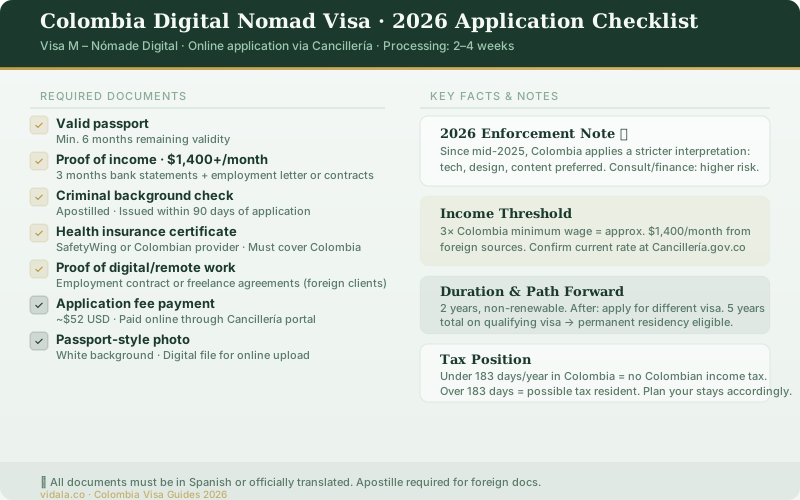
Required Documents
1. Valid passport
- At least 6 months of remaining validity at time of application
- Clear copy of bio page (photo page)
2. Passport-style photos
- 3×4 cm format
- White background, front-facing
- Taken within the past 6 months
3. Completed online application form
- Submitted at visascolombia.cancilleria.gov.co
- Select: Visa type M (Migrante) → Subcategory: Nómade Digital
- All fields must be completed; incomplete forms are returned without review
4. Proof of remote employment or contracts
If you’re employed by a foreign company:
- Letter on company letterhead, signed by HR or management
- Must state: your role, your monthly salary, that you work remotely, and that the company is based outside Colombia
- Letter should be in Spanish or include a certified Spanish translation
If you’re a freelancer or independent contractor:
- Signed client contracts (minimum 2–3 contracts)
- Contracts must show: client name and address (outside Colombia), your services, agreed payment
- Payment history records: Wise, PayPal, Payoneer, or bank wire statements cross-referencing to these contracts
5. Proof of income: last 3 months
- Bank statements showing consistent monthly deposits ≥ $1,410/month
- Payroll slips or salary confirmations (for employees)
- The income must visibly tie to foreign sources: deposits labeled “salary,” “wire transfer from [foreign company],” etc.
- Payoneer and Wise statements are accepted but must cross-reference with bank deposits
6. Health insurance covering Colombia
- Must cover medical expenses of at least $35,000 USD
- Must cover Colombia for the full visa duration requested
- Policy documents must show coverage dates, coverage territory (must include Colombia), and coverage amounts
7. Application fee payment receipt
- $55 USD, paid online at the Cancillería portal
- Visa/Mastercard accepted; some international cards declined, so have a backup
8. Application fee payment confirmation
- Screenshot or PDF of payment confirmation
Optional but Strongly Recommended
- Employment contract / master services agreement (not just the letter; shows stability and formal relationship)
- Tax return or accountant letter confirming your annual income for the prior year
- Proof of accommodation in Colombia (lease agreement, Airbnb confirmation, or hotel booking for arrival period)
- Cover letter in Spanish summarizing your situation and why you meet the requirements (not required, but some applicants find it helps with borderline cases)
How to Apply: Step by Step
Step 1: Gather All Documents (1–3 Weeks)
Timeline dominates here. If you need an apostilled employment letter, add 2–4 weeks for that process in your home country. If you need to build up 3 months of clean income documentation, you need to plan that far ahead.
Get health insurance in place before you start the application. SafetyWing Nomad Insurance activates within days and satisfies the Colombia visa coverage requirement at around $47/month. Have your policy document ready before you open the Cancillería portal.
Any documents not originally in Spanish or English need certified translation. Translations must be done by an official certified translator, not a bilingual friend, not Google Translate.
Step 2: Create Your Account on the Cancillería Portal
Go to visascolombia.cancilleria.gov.co and create an account with your email address. The system is in Spanish. Chrome’s auto-translate handles it adequately, but for anything important, understand what you’re clicking.
Navigate to: Solicitar Visa → M (Migrante) → Nómade Digital
Step 3: Complete the Application and Pay the Fee
Fill out all form fields. The system checks for completeness before submission. Upload all documents as PDFs: maximum 2MB per file; compress larger files before uploading.
At the end of the form, pay the $55 application fee. Payment goes through the Cancillería’s payment processor. US-issued Visa and Mastercard work reliably; some international cards are declined. If your card fails, try PayPal or a different card.
Submit. You’ll receive an email confirmation with a tracking number.
Step 4: Wait for Review
Processing time: 5–30 business days. The typical timeline is 10–15 business days from submission to decision.
Migración Colombia may send an email requesting additional documents (requerimiento). Monitor your inbox. You have a limited window to respond (usually 10 business days). Missing the requerimiento deadline counts as an abandonment; you’d need to reapply.
Don’t book non-refundable flights or sign a lease before you have your approval. The processing window is wide enough that this is a real risk.
Step 5: Receive Decision
If approved, you’ll receive an email notification. Pay the $230 issuance fee at the Cancillería portal. The visa is then issued as a PDF. Download it and save it in multiple places. Print a physical copy for your arrival in Colombia.
If rejected, you’ll receive a formal rejection notice. It will state the reason. Request the full explanation if it isn’t provided. Common rejection reasons and how to fix them are covered below.
Step 6: Enter Colombia and Register for Your Cédula
Present your visa PDF at immigration upon entry to Colombia. Your passport gets stamped.
Within 15 days of arrival, register at any Migración Colombia office to obtain your cédula de extranjería (foreign ID card). This is not optional; it’s a legal requirement. The cédula costs approximately $20, and a digital copy is issued the same day at the office. The physical card takes 1–3 weeks to arrive.
The cédula is necessary for:
- Opening a Colombian bank account
- Signing a lease
- Getting a local SIM card with a Colombian plan
- Accessing some healthcare services
Do this in week one. It’s a straightforward in-person appointment; bring your passport, visa PDF, and $20.
Income Proof: The Most Common Rejection Reason
Most rejections come down to income documentation. Here’s the nuance that most guides skip.
What “3× Minimum Wage” Actually Means in Practice
The 2026 threshold is COP 5,252,715/month, approximately $1,410 USD at current rates. That’s the legal minimum. But Migración Colombia looks at your income holistically: is it consistent? Is it clearly from foreign sources? Is there a plausible professional relationship underlying it?
Three months of consistent deposits that clearly trace to foreign clients or an employer is the strongest package. Sporadic large deposits that don’t match any contract or employment relationship raise flags. A $10,000 lump sum in month one and $0 in months two and three does not satisfy the spirit of the requirement.
Employees: Straightforward
If you have a payslip from a foreign employer and a clear employment letter, your application is the simplest version of this. Make sure the letter explicitly states your salary in USD or COP, your remote status, and your employer’s country of incorporation.
Freelancers: More Work Required
Freelancers face extra scrutiny. Migración Colombia wants to see:
- Multiple client contracts (not just one)
- Payment history from each client
- Bank statements showing the inflows match the contracts
- Ideally, 6+ months of this history (even though they only require 3)
If your income is inconsistent (project work with gaps, seasonal client work, or new freelance relationships started in the last few months), this is where rejection happens. A cover letter explaining your business model and income structure helps. An immigration lawyer helps more.
What If You’re Rejected
Rejection is not a ban. You can reapply immediately after fixing the gap.
The rejection notice will cite the specific reason. Common ones:
- Income threshold not met (bank statements don’t show $1,410/month consistently)
- Missing apostille on employment letter
- Health insurance doesn’t cover Colombia or has insufficient coverage amount
- Employment letter too vague (doesn’t specify remote status, salary, or employer location)
- Documents not in Spanish or without certified translation
Address the specific issue and reapply. Many first-time rejections lead to successful second applications. For the second attempt, strongly consider hiring an immigration lawyer. They know what Migración Colombia is currently looking for. Cost: $200–$500 for a lawyer to review and package your application.
Health Insurance: What Actually Satisfies the Requirement
The requirement: coverage for medical expenses of at least $35,000 USD, including Colombia, for the visa duration you’re requesting.
SafetyWing Nomad Insurance at $47/month, no long-term contract, covers Colombia at the required level. This is what most applicants use because it activates fast and the PDF is clean for document submission. Satisfies the visa requirement; continues month-to-month so you can switch once established.
World Nomads at $80–$120/month, with higher adventure sports coverage, is good if you’re doing outdoor activities. Also satisfies the requirement.
Local Colombian insurance (Sura, Colsanitas) offers better long-term value ($60–$100/month for comprehensive local coverage), but requires your cédula to set up. The strategy for most people: get SafetyWing or World Nomads for the application and first few months, then switch to Sura or Colsanitas once you have your cédula and plan to stay.
Costs: What You’ll Actually Pay
| Item | Cost |
|---|---|
| Application fee | $55 USD |
| Visa issuance fee (if approved) | $230 USD |
| Health insurance — 12 months (SafetyWing) | ~$564 |
| Health insurance — 12 months (World Nomads) | ~$1,080 |
| Immigration lawyer (recommended for freelancers) | $200–$500 |
| Apostille of employment letter | $20–$100 (varies by country) |
| Certified Spanish translation (if needed) | $30–$80 per document |
| Cédula de extranjería | ~$20 |
| Total: employee, no lawyer, SafetyWing | ~$870 |
| Total: freelancer, with lawyer, SafetyWing | ~$1,350–$1,650 |
The visa fees themselves are reasonable. At $285 total for 2 years of legal residency, that’s about $12/month. The variable cost is the insurance and whether you use a lawyer.
Where to Base Yourself: Life on the Nomad Visa
Medellín
The obvious choice for most digital nomads, and usually the right one. Medellín has the strongest nomad infrastructure in Colombia: established coworking spaces, a large English-speaking expat community, spring-like weather year-round (about 72°F average), and the cheapest flight connections to the US from any major Colombian city.
Neighborhoods:
- El Poblado: tourist-facing, expensive, English everywhere, highest expat density. 1BR furnished: $600–$1,200/month. The most convenient first base; gets repetitive for long-term stays.
- Laureles: better balance of local and expat. Quieter, better value, real neighborhood feel. 1BR furnished: $400–$700/month. Where most long-term Medellín nomads land.
- Envigado: south of El Poblado, technically a separate municipality. Quieter, cheapest of the three, growing expat community, excellent coffeeshops. 1BR furnished: $350–$600/month.
Coworking:
- Selina Medellín (El Poblado): global brand, reliable, $15–$25/day or monthly passes
- Atom House (Laureles): popular with longer-term residents, community-oriented
- WeWork (El Poblado): corporate standard, good for video calls, $200–$350/month
Cost of Living in Medellín, Colombia — full breakdown with neighborhood rent tables.
Bogotá
Colombia’s capital is a business hub rather than a nomad hub. The altitude (2,600m) takes adjustment. The city is culturally richer and more complex than Medellín. Neighborhoods Chapinero and Usaquén have good expat infrastructure; 1BR furnished: $600–$1,100/month.
Better for: people doing business in Latin America, consultants with local client meetings, people who prioritize cultural depth over social scene.
Cali
Warmer, cheaper, salsa-focused. Fewer coworking options than Medellín but a great fit for nomads who want authentic Colombian city life. → Cali expat guide
Cartagena
The Caribbean walled city on the coast. Beautiful, historically significant, and genuinely expensive compared to Medellín. Touristy, especially in Bocagrande and El Centro. The coast and islands are spectacular. Better as a temporary base for 1–3 months than a full-time nomad city. 1BR furnished in Bocagrande or the historic center: $700–$1,400/month.
Book a furnished scouting apartment in Booking.com with a monthly rate, filtering for Laureles or El Poblado in Medellín for the first month while you find a longer-term place. Monthly rates are typically 30–50% below nightly rates.
For getting money into Colombia: Wise sends USD to Colombian peso accounts at under 1% fee, and Wise account statements are accepted by Migración Colombia as valid income proof documentation.
A Real Example: What the Process Looks Like
Sofia is a UX designer, 34, earning $3,200/month from two US tech companies. She applied for the Colombia digital nomad visa in January 2026 from the US.
Week 1: Gathered documents: employment letters from both companies, last 3 months of bank statements, signed contracts. Got SafetyWing coverage. Had employment letters apostilled through her state’s Secretary of State.
Week 2: Created her Cancillería account, filled the online form, uploaded all documents, paid the $55. Submitted.
Week 3: Received a requerimiento. Migración wanted her employment letters translated into Spanish. She hired a certified translator ($60/letter). Submitted translations within the response window.
Week 6: Approval. Paid the $230 issuance fee. Downloaded visa PDF.
Week 7: Flew to Medellín. Arrived, passport stamped. Booked an appointment at Migración Colombia office.
Week 8: Got her cédula. Opened a Bancolombia account two weeks later once the cédula was in the system.
Total time from starting document collection to having cédula in hand: 8 weeks. Total cost: ~$1,000 (fees + insurance + translation). She didn’t use a lawyer, which worked given her clean employment documentation.
Frequently Asked Questions
Can I bring my family on this visa?
Colombia’s digital nomad visa doesn’t have a built-in dependent option. Family members must apply separately. Spouses or partners can apply for their own M visa if they meet the criteria independently, or apply for a visitor/tourist entry. If your spouse doesn’t have qualifying income, consult an immigration lawyer about dependent visa pathways under the M category.
Can I work for a Colombian company on this visa?
No. The Nómade Digital subcategory specifically authorizes remote work for foreign clients or employers. Working for a Colombian company requires a different visa category: an employment-based visa with a work contract from a Colombian employer and authorization from the Ministry of Labor. This is a meaningfully different process.
Does the nomad visa count toward permanent residency?
Yes. Time on certain M visa types counts toward the 5-year accumulation needed for permanent residency eligibility. The exact rules on which visa types count and how they aggregate have some nuance; consult an immigration lawyer if permanent residency is your goal.
What if my income drops below the threshold mid-visa?
The visa can technically be revoked if you no longer meet the conditions under which it was granted. In practice, Migración Colombia doesn’t audit this frequently. But if you know your income will drop significantly for an extended period, consult a lawyer about your options. Don’t let it slide and hope nobody notices, as that can create complications when you renew or apply for other visa types.
Can I exit and re-enter Colombia freely on this visa?
Yes. The visa covers 2 years of legal status in Colombia; you’re not required to be physically present continuously. You can travel freely in and out. The only timing issue is the cédula registration within 15 days of your initial entry. After that, come and go as needed.
What’s the tax situation?
Colombia taxes residents on worldwide income once they’ve been in the country for 183+ days in any 12-month period. Under that threshold, Colombian income tax applies only to Colombian-sourced income, not foreign remote earnings. Track your days if you’re staying 5–6 months at a time. US citizens are taxed on worldwide income by the IRS regardless of Colombia’s rules. The Foreign Earned Income Exclusion (Form 2555) applies if you qualify; consult a cross-border tax professional.
Concrete Next Steps
-
Confirm your income meets 3× the 2026 minimum wage ($1,410/month). If you’re borderline, budget $2,000+ in consistent documented monthly income before applying.
-
Get health insurance in place. SafetyWing activates within a day or two and satisfies the visa requirement; have the policy PDF ready before you open the application.
-
Gather 3 months of clean income documentation: bank statements, employment letter or client contracts. This is the step most people underestimate.
-
Decide on DIY vs. lawyer. Employees with clean documentation can do this themselves; freelancers with variable income should seriously consider a $200–$400 consultation with a Colombian immigration lawyer.
-
Apply at visascolombia.cancilleria.gov.co. The portal is functional; allow 15–30 business days for a decision.
-
Book a flexible first month in Colombia. Don’t sign a 6-month lease until you’ve arrived and tested the city. Booking.com has monthly-rate furnished apartments in Laureles and El Poblado.
Once you’re in with your cédula: open a local bank account, find a longer-term apartment, and settle in. Two years goes faster than you expect.
Cost of Living in Medellín, Colombia — where to live, what to budget, and what Medellín actually costs month to month.