
Healthcare in Ecuador for Expats: Insurance, Costs & Quality Guide (2026)
A specialist visit at a top private hospital in Quito costs $40–$60. The same MRI that runs $1,500–$3,000 in the US goes for $150–$300 in Ecuador. This is why healthcare is one of the most frequently cited reasons Americans and Canadians choose Ecuador for retirement; not the weather (though the eternal spring in Cuenca doesn’t hurt), and not the low cost of living generally, but specifically the healthcare math.
That said, the healthcare question is genuinely complicated. Ecuador has three different systems an expat can use; public IESS, Ecuadorian private insurance, and international plans, and each makes sense for a different type of person. The quality picture also varies: Quito’s top private hospitals operate at a level most expats would consider excellent; a small-town clinic in the Oriente does not. This guide gives you an honest picture so you can make an actual decision.
For full relocation context; visas, cost of living, neighborhoods; see Moving to Ecuador: Complete Guide.
How Good Is Healthcare in Ecuador?: Honest Assessment
Private Healthcare (What Most Expats Use)
The short version: private healthcare in Quito is good. Not world-class across the board, but good enough that most expats use it confidently for routine care, specialist visits, and even elective procedures.
Hospital Metropolitano in Quito is the flagship: a large, modern facility with specialist depth, English-speaking staff on request, and a patient experience that’s noticeably organized by Latin American standards. It’s the only JCI-accredited hospital in Ecuador, which is the same international standard US hospitals get audited against. Hospital Voz Andes, also in Quito, is run by a missionary organization and has an exceptionally strong reputation among expats and Ecuadorians alike. Clínica Kennedy in Guayaquil is the coastal equivalent.
Many Ecuadorian specialists trained in the US, Spain, or other European countries. In cardiology, orthopedics, and oncology specifically, Quito has genuine specialist depth. You won’t get the same depth of subspecialty as at a major US academic medical center, but for most conditions a retiree actually deals with, you’ll be well covered.
Equipment is modern at top private hospitals in Quito and Cuenca. It’s more variable at second-tier facilities and significantly more limited in provincial cities and rural areas.
Public Healthcare (IESS and MSP)
Ecuador’s public healthcare system covers Ecuadorians and legal residents. The Sistema Nacional de Salud (SNS) includes free public hospitals run by the Ministry of Health (MSP) and the IESS contributory insurance system.
Public hospital quality is genuinely mixed. Emergency care is generally adequate: the system handles trauma and acute illness. But non-urgent specialist care comes with long waits, facilities are inconsistently maintained, and medication shortages happen. This isn’t a knock on Ecuadorian healthcare specifically; it’s the reality of most public systems at their funding levels.
The honest recommendation for most expats: public facilities as backup, private for routine and specialist care.
Small Cities and Rural Areas
Cuenca is the exception to the “small city = limited care” pattern. Ecuador’s most popular expat retirement destination has two well-regarded private hospitals; Hospital Monte Sinaí and Clínica Santa Inés: and a range of specialist services that punches above what you’d expect for a city of 650,000. This is part of why so many expat retirees specifically choose Cuenca: the healthcare is good enough that you don’t feel like you’re making a medical trade-off to live there.
Outside Quito and Cuenca, the picture gets harder. Coastal areas (Salinas, Manta, Montañita) have adequate clinics for basic care but transfer serious cases to Guayaquil. The Oriente (Amazon region) has limited private healthcare infrastructure. If you’re considering living outside the major cities, visit first and locate the nearest private hospital before committing.
What Does Healthcare Cost in Ecuador?
This is the table no competitor includes. These are real private-pay prices at Quito private facilities, verified in early 2026.
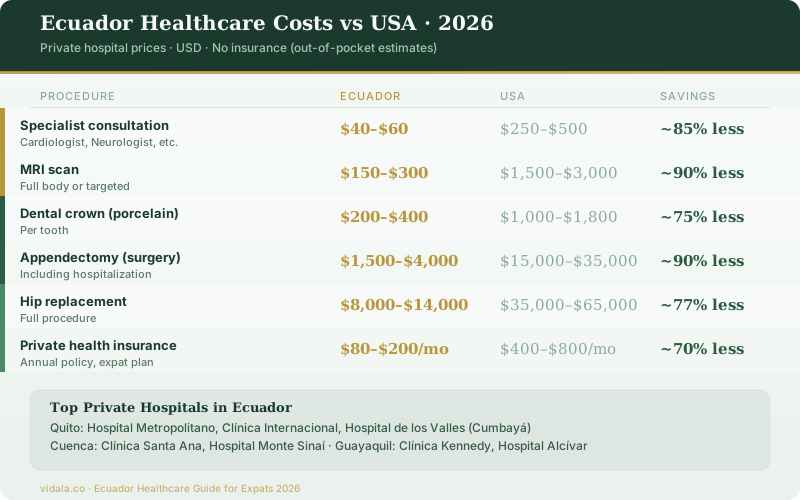
| Service | Private cost (Quito) | US equivalent |
|---|---|---|
| GP consultation | $20–$40 | $150–$300 |
| Specialist consultation | $40–$60 | $200–$500 |
| Dentist (cleaning + exam) | $25–$50 | $100–$200 |
| Dental filling | $30–$60 | $150–$300 |
| Blood work (full panel) | $15–$35 | $100–$400 |
| X-ray | $20–$40 | $200–$500 |
| MRI | $150–$300 | $1,500–$3,000 |
| Emergency room visit (private) | $80–$200 | $1,500–$3,000 |
| Day surgery (private hospital) | $800–$2,500 | $10,000–$30,000 |
| Hospital stay (private, per night) | $200–$400 | $2,000–$5,000 |
| Appendectomy (private) | $3,000–$6,000 | $30,000–$50,000 |
| Hip replacement (private) | $8,000–$14,000 | $40,000–$100,000 |
These numbers are not cherrypicked. They reflect real private facility pricing. The appendectomy comparison is particularly illustrative: a procedure that bankrupts uninsured Americans in the US costs $3,000–$6,000 in Ecuador at a top private hospital; less than most US insurance deductibles.
Prescription Medications
Brand-name medications run 40–70% cheaper than US retail pricing. Common generics cost $2–$10. The caveat: specialty medications and some less common brand names aren’t always stocked. If you take a specialty medication for a chronic condition, bring a 3-month supply when you move and find a Quito-based pharmacy that can reliably source it before your stock runs out. The Fybeca and Pharmacy’s chains are the most reliable; pharmacists can advise on substitutions for common medications without a prescription.
Insurance Options for Expats in Ecuador
There are three real options, plus the “no insurance” approach which I’ll address briefly at the end.
Option 1: IESS (Public Insurance)
IESS is Ecuador’s public social security and insurance system. Foreigners with Ecuadorian residency visas can enroll voluntarily.
Monthly cost: IESS contributions are calculated at 17.6% of your declared monthly income. If you declare the minimum wage base ($482/month in 2026), your contribution is approximately $85/month. Most expats who enroll declare income in a range that puts their contribution at $85–$130/month.
Coverage: Full coverage on paper; doctor visits, hospitalization, surgeries, prescription medications, dental (partial). The catch is that you access care through IESS facilities, which have the wait time and quality variations of any public system.
To enroll: You need your Ecuadorian cedula (identity card) and residency certificate. Go to the nearest IESS office with these documents and your RUC (tax ID). The process takes a few hours and requires a bit of patience with paperwork but is straightforward for anyone with some Spanish or a local helper.
Pros: Very low cost, covers most needs, includes medications, no pre-existing condition exclusions after a 12-month waiting period.
Cons: Wait times for non-urgent specialist care; can’t use top private hospitals unless paying out-of-pocket; geographic limitations; no coverage outside Ecuador.
Best for: Long-term permanent residents who are reasonably healthy, comfortable navigating the system in Spanish (or with a helper), and primarily want cost protection for catastrophic events rather than VIP private hospital access.
Option 2: Ecuadorian Private Insurance
Ecuador’s private insurance market is functional but limited in scope. Providers include BMI Ecuador, Seguros Equinoccial, AIG Ecuador, and Salud Total.
Monthly cost: $80–$200/month for a healthy adult; premiums climb with age and vary by coverage tier.
Coverage: Private hospitals in Ecuador (including the top ones; Metropolitano, Voz Andes, Kennedy); no international coverage.
Pros: Access to Quito’s best private hospitals; faster than IESS; claims handled locally.
Cons: No international coverage; pre-existing conditions typically excluded or surcharged; claims processes can be slow and in Spanish; limits are lower than international plans.
Best for: Permanent residents who plan to stay in Ecuador long-term, don’t travel internationally often, and want private hospital access without paying international plan premiums.
Option 3: International Health Insurance
International plans cover you in Ecuador and when you travel; including optional US emergency coverage on many plans. For most expat retirees, this is the recommended first-year option.
Monthly cost: $100–$400+/month depending on age, plan tier, and coverage options. A healthy 60-year-old typically pays $200–$300/month for solid coverage.
Cigna Global is our top recommendation for Ecuador retirees 55+. Their plans include Latin America as a coverage region with optional US emergency coverage, English-language customer service, and efficient claims handling. Plans start around $150/month for basic coverage; most retirees opt for the mid-tier Gold level at $200–$300/month depending on age. Cigna also satisfies the Ecuador retirement visa health insurance requirement.
Allianz Care is a strong alternative, particularly for those who travel frequently between Ecuador and Europe, or who want a plan with strong US coverage included as standard rather than optional.
SafetyWing at approximately $47/month is the budget option; primarily travel medical insurance with emergency and evacuation coverage. It works for digital nomads on shorter stays, for expats who already have local insurance and want supplementary international coverage, or for your scouting trip before you set up a full plan. Not the right primary insurance for a retiree with ongoing health needs.
Pros: Covers Ecuador and international travel; option for US emergency coverage; English support; high coverage limits; satisfies visa insurance requirements.
Cons: More expensive than local options; complex plan structures; some plans have US coverage exclusions or sub-limits (read the fine print).
Best for: Expat retirees and nomads who travel back to the US or internationally; anyone who wants the flexibility of the best private hospitals without pre-authorization friction.
A Note on Self-Pay (No Insurance)
Going without insurance is viable for a healthy person in their 40s or early 50s with a solid liquid emergency fund ($50,000+). The low cost of care in Ecuador means that routine care is genuinely manageable out-of-pocket.
But for older retirees, anyone with a chronic health condition, or anyone who doesn’t have a large accessible emergency fund: this is not a reasonable strategy. A major surgery or hospitalization can run $6,000–$15,000. Evacuation to the US without insurance coverage can cost $30,000–$80,000. The risk-reward doesn’t work. At minimum, carry emergency and evacuation coverage (SafetyWing or equivalent) even if you’re otherwise self-paying.
IESS vs. Private vs. International: Which Is Right For You?
| IESS | Ecuadorian Private | International | |
|---|---|---|---|
| Monthly cost | $85–$130 | $80–$200 | $150–$400+ |
| Requires residency? | Yes | No | No |
| International coverage | No | No | Yes |
| US emergency coverage | No | No | Optional |
| Wait times | Long for non-urgent | Short | Short |
| Hospital access | IESS facilities | Top private | Top private |
| Pre-existing conditions | Covered after 12 months | Usually excluded | Usually excluded or surcharge |
| Best for | Long-term budget residents | Local residents, no travel | Nomads, retirees, frequent travelers |
The practical recommendation for most arriving expats: start with an international plan (Cigna Global or Allianz Care) for your first year. It satisfies the visa requirement, gives you immediate private hospital access, and buys you time to understand the system. After 12–18 months on the ground with your cedula in hand, reassess whether IESS enrollment or an Ecuadorian private plan makes sense to layer in or replace.
Ecuador Retirement Visa and Health Insurance
The Ecuador Jubilado (retirement) visa requires proof of health insurance that covers you during your stay in Ecuador. International plans from Cigna, Allianz, and SafetyWing all satisfy this requirement.
The sequence most expats follow: get international insurance → apply for Jubilado visa → receive cedula after approval → evaluate IESS enrollment as a complement or replacement. After you have your cedula, IESS enrollment becomes available and you can decide whether the cost savings make sense relative to the trade-offs in access and wait times.
For the full visa application process, document requirements, and income thresholds, see our Ecuador Visa Guide.
What to Do in a Medical Emergency
This is the section most healthcare guides omit. Know this before you need it.
For serious emergencies: Go directly to the private hospital ER. Hospital Metropolitano or Voz Andes in Quito, Hospital Monte Sinaí or Clínica Santa Inés in Cuenca. Private ERs are faster, better equipped, and less chaotic than public emergency rooms. Entry costs $80–$200 but you’ll get care quickly.
Ambulance: Call 911. Emergency response in Ecuador has improved but is not uniformly reliable outside Quito. In many parts of the country, getting yourself to the hospital by taxi or Uber is faster than waiting. Know your nearest private hospital address and have it saved.
Medical evacuation: Your international insurance plan should include this. Evacuation to the US or another country for treatment not available in Ecuador can cost $30,000–$80,000 without coverage. Confirm your plan includes this before you buy it.
Embassy resources: Register with the US Embassy’s STEP (Smart Traveler Enrollment Program) before you arrive. They maintain lists of English-speaking doctors and hospital contacts and will assist US citizens in medical emergencies.
Dentistry in Ecuador
Dental care deserves its own mention because the quality-to-price ratio is exceptional. A cleaning and exam costs $25–$50. Fillings run $30–$60. More complex work; crowns, root canals, implants; costs 70–80% less than US prices.
Cuenca has become a legitimate dental tourism destination. Expats from the US and Canada schedule dental procedures specifically around visits, combining weeks of travel with significant dental work that would cost multiples more at home. Quito also has excellent private dental practices, including specialists (orthodontists, oral surgeons, periodontists) trained abroad.
Ask for recommendations in Facebook groups like “Expats in Cuenca” or “Expats in Quito”; word-of-mouth referrals for dentists are more reliable than general internet searches.
Finding Doctors and Specialists
English-speaking doctors: Hospital Metropolitano in Quito has staff who speak English; request it when booking. Beyond top Quito hospitals, English fluency among doctors is hit-or-miss. Download Google Translate if your Spanish is limited; it handles medical conversations adequately in a pinch.
Pharmacy: Fybeca and Pharmacy’s are nationwide chains with reliable stock. Ecuadorian pharmacists can recommend and dispense many medications without a prescription; useful for minor illnesses and common conditions. For chronic medications, develop a relationship with a specific pharmacist who knows your needs.
Specialist referrals: The expat communities in Quito (Facebook: “Expats in Quito”) and Cuenca (“Expats in Cuenca” and “Gringos in Cuenca”) are active and will give you real, experience-based doctor recommendations. This is more reliable than any directory for finding specialists you can trust.
Cuenca vs. Quito Healthcare
For the large number of expat retirees who are choosing between Cuenca and Quito, healthcare is a real consideration.
Quito has greater specialist depth; more subspecialties, better-equipped facilities for complex procedures, and the most internationally-connected hospitals. If you have a serious chronic condition requiring ongoing specialist management, Quito’s breadth is an advantage.
Cuenca has excellent private hospitals for most needs, and the proximity (two doctors I know personally in Cuenca trained at equivalent programs to what you’d find in Quito) means the day-to-day quality gap is smaller than people expect. For routine care, annual checkups, and most common procedures, Cuenca is more than adequate. It’s smaller, which means some very specific subspecialties aren’t available locally, but Quito is a 4-hour drive or 1-hour flight for anything requiring that level of specialization.
Our Cuenca Expat Guide goes into more detail on living in Cuenca specifically.
Frequently Asked Questions
Can I use Medicare in Ecuador? No. Medicare does not cover international care with almost no exceptions. This is non-negotiable and the most common misconception among American retirees planning abroad. You need private insurance. Medicaid is similarly US-only.
What if I have a pre-existing condition? IESS covers pre-existing conditions after a 12-month waiting period: the best option in this scenario for long-term residents. Ecuadorian private insurance typically excludes pre-existing conditions entirely or charges significant surcharges. International plans also typically exclude pre-existing conditions or charge extra; full disclosure at application is essential (undisclosed conditions get your claim denied). If you have serious ongoing health conditions, IESS enrollment after residency is the most financially protective path.
Are my medications available in Ecuador? Most common medications are available in branded or generic form, significantly cheaper than US pricing. Specialty, rare, or very new medications may not be reliably stocked. Bring a 3-month supply of specialty medications and work with a local pharmacist to source ongoing supply before you run out.
Is Ecuador safe for major surgery? At top private hospitals in Quito and Cuenca, yes. The quality is comparable to mid-tier US hospital standards at 10–20% of the cost. Complex cardiac surgery or rare cancer procedures may warrant returning to the US; discuss with your specialist. But for common major procedures (orthopedic, general surgery, cardiac stenting), Ecuador’s top private hospitals are genuinely capable.
Is healthcare better in Cuenca or Quito? Quito has more specialist depth. Cuenca has very good private hospitals for most expat needs and is the preferred retirement destination for people who prioritize lifestyle alongside healthcare access. For most common conditions, Cuenca is sufficient. For complex subspecialty care, Quito has the edge.
The Practical Path Forward
Ecuador’s healthcare is a genuine advantage for expats; quality private care at costs that make the healthcare math dramatically different than staying in North America. The decision on insurance comes down to your situation:
- Arriving for the first time: Get an international plan (Cigna Global is the best starting point for retirees) → it satisfies your visa requirement and gives you immediate private hospital access
- After settling with cedula: Evaluate IESS enrollment; it’s cheap and covers pre-existing conditions after 12 months, which is uniquely valuable
- Digital nomad or short stay: SafetyWing from $47/month is adequate for emergency and evacuation coverage on shorter stays
Get a quote from Cigna Global to see actual pricing for your age and coverage preferences. Compare against SafetyWing if budget is the primary constraint. Then book your scouting trip to Ecuador; see the hospitals in person, visit a Quito or Cuenca clinic, and you’ll understand quickly that the healthcare concern is real but manageable.
For detailed cost of living in Quito, including how healthcare expenses fit into a monthly budget, see our Quito Cost of Living Guide.
Prices and insurance costs as of early 2026. Verify current premiums directly with insurers before purchasing.