
Ecuador Visa Guide 2026: Every Option Explained
Ecuador overhauled how it handles visa applications in 2026. Everything is now online through the E-Visa portal: no more showing up at immigration offices with paper documents. The income threshold went up: $1,458/month (3× the updated Basic Salary Unit of $486). And health insurance is now a hard requirement for every residency application, not an afterthought.
Most of the Ecuador visa content you’ll find online is already outdated, citing the old $1,350 or $1,446 income threshold, the old $270 issuance fee ($400 now), and missing the mandatory health insurance requirement entirely. This guide reflects the 2026 system as it actually operates.
This covers every visa pathway Ecuador offers (tourist entry through permanent residency and citizenship), the specific 2026 requirements for each, the step-by-step E-Visa application process, and the mistakes that get applications rejected. Retirees evaluating the Pensioner Visa, remote workers on the Rentista path, and real estate investors exploring the Investor Visa will all find their numbers and process here.
Tourist Entry: Do You Need a Visa for Ecuador?
US, Canadian, and EU citizens don’t need a visa to enter Ecuador. You arrive, get stamped, and have 90 days. The passport needs at least 6 months of validity remaining, and technically you should have proof of onward travel and funds, though these are rarely checked in practice.
The 90 days can be extended. Before your first 90 days expire, apply at the nearest Ministerio de Relaciones Exteriores office for an extension, which gets you up to 180 days total within any 12-month period. Don’t leave it to the last week; appointment availability varies by city.
One thing people miss: The 180-day limit is within a 12-month period, not a calendar year. If you left Ecuador and came back, Ecuador immigration counts your cumulative days. Overstaying 180 days results in fines and can affect future visa applications.
If you’re just visiting for 1-3 months, that’s all you need to know. The rest of this guide is for people planning to stay longer.
Ecuador’s Visa System in 2026: What Changed
The E-Visa System: Applications Are Now Online
As of 2026, all residency visa applications go through Ecuador’s official E-Visa portal (managed by the Ministerio de Relaciones Exteriores). Immigration offices no longer accept paper applications at the counter.
This is a meaningful improvement in some ways. You can start your application from the US, upload documents from home, and track status online. The tradeoff: the portal has had growing pains, including occasional system outages and inconsistent document standards between reviewers. You’ll still need to travel to Ecuador for biometrics (fingerprinting and photo) after your application is approved, and for cedula pickup.
The E-Visa system applies to all visa categories: retirement, rentista, digital nomad, investor, professional, and family reunification.
The 2026 Income Threshold: $1,458/Month
Ecuador ties most of its visa income requirements to the Basic Salary Unit (SBU), updated annually. For 2026, the SBU is $486/month. Most residency visas require 3× SBU: $1,458/month.
This replaces the figures you’ll see in older guides: $1,350 (pre-2025 SBU), $1,446 (based on the $482 SBU from early 2025 guidance). The correct 2026 number is $1,458.
Each dependent you add to your application (spouse, children under 18) requires an additional $250/month of documented income.
Health Insurance Is Now Mandatory
Every temporary residency visa application must include proof of health insurance that covers medical care within Ecuador for the full visa duration. This isn’t optional and it’s not satisfied by travel insurance that excludes Ecuador or caps coverage at $50,000.
Accepted providers:
- International plans: SafetyWing, Cigna Global, Allianz
- Ecuadorian providers: Ecuamedical, Bupa Ecuador (BMI)
SafetyWing is the most commonly cited option among expats applying for the visa. It starts around $47/month for people under 40 and is widely reported as accepted by Ecuador immigration. Once you have residency and a cedula, switching to a local Ecuadorian insurer usually makes more financial sense for long-term coverage.
What It Costs in 2026
Two government fees, paid separately:
| Fee | Amount | When Paid |
|---|---|---|
| Application fee (non-refundable) | $50 | At submission |
| Visa issuance fee | $400 | After approval |
| Cedula (ID card) | ~$15 | At biometrics appointment |
| Total government fees | ~$465 | — |
Older content cites $270 as the issuance fee. That’s the old number. It’s $400 now.
On top of government fees, budget for document preparation: apostille services ($50-100/document), certified Spanish translations ($30-80/document), and if using an immigration lawyer, $500-1,500 in professional fees.
All Visa Options: Which One Are You?
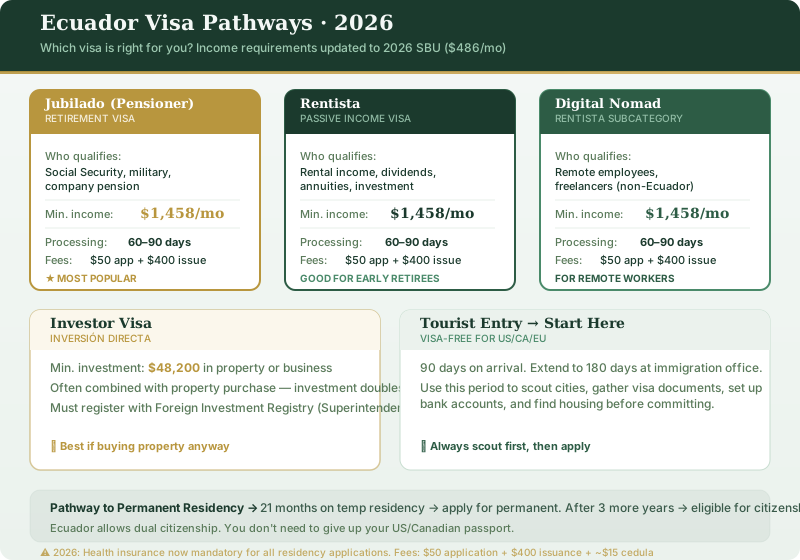
Retirement / Pensioner Visa (Jubilado)
The most straightforward option if you’re receiving a pension.
Who it’s for: Retirees drawing a recognized pension (US Social Security, government pensions, corporate retirement plans, military retirement). The income must be specifically pension-sourced, not general investment income.
Income requirement: $1,458/month from pension sources
Key documents:
- Official pension benefit letter from the issuing organization
- 3 months of bank statements showing pension deposits
- Health insurance proof
- Criminal background check (apostilled)
- Passport photos
Important distinction: If your retirement income comes from dividends, rental properties, or investment accounts rather than a formal pension, this visa category doesn’t apply to you. Look at the Rentista below. The immigration reviewers are attentive to this.
Processing time: 60–90 days from complete application submission
Validity: 2 years, renewable. After 21 months of continuous residence, you become eligible for permanent residency.
Rentista Visa: For Remote Workers and Passive Income
This is Ecuador’s closest equivalent to a digital nomad visa, even though Ecuador doesn’t market it with that label.
Who it’s for: Anyone earning $1,458/month or more from non-Ecuadorian sources: remote employment, freelancing, consulting, rental income from foreign properties, dividends, or investments.
Income requirement: $1,458/month documented from foreign sources
Key documents:
- Employment contract (if employed) or client contracts / proof of business
- 3 months of bank statements showing consistent deposits at or above the threshold
- Health insurance proof
- Criminal background check (apostilled)
The “digital nomad” question: Ecuador doesn’t have a visa with that name. The Rentista is functionally equivalent. If you’re a freelancer or remote employee working for companies outside Ecuador, the Rentista is your category.
On working for Ecuadorian employers: The Rentista visa does not authorize you to work for an Ecuadorian employer or accept local employment. If you want to work within Ecuador’s economy, you need the Professional or Employment visa. This distinction matters.
Tax position: Stay under 183 days per year in Ecuador and foreign income isn’t subject to Ecuadorian income tax. Spend more than 183 days and you may become a tax resident, which matters for anyone planning a year-round base.
Processing time: 60–90 days Validity: 2 years, renewable
Professional Visa
For foreign professionals who have a job offer from an Ecuadorian employer.
Who it’s for: Someone relocating for Ecuadorian employment at a local company, NGO, or institution.
Income requirement: $486/month (1× SBU), the lowest income threshold of any visa category, because the Ecuadorian employer is part of the equation.
The SENESCYT step: Before applying for the visa, your foreign degree must be recognized by Ecuador’s national education authority (SENESCYT). This is a separate process that takes 2–4 months on its own. Don’t start the visa clock without accounting for this.
Processing time: 90–120 days total (including SENESCYT recognition)
This visa is not for remote workers or freelancers (those are Rentista). It’s specifically for people entering formal Ecuadorian employment.
Investor Visa
For foreign nationals making a qualifying investment in Ecuador.
Investment requirement: Approximately $42,500 (roughly 87.5× SBU; the formula ties to the SBU, so verify against the current rate when applying)
Qualifying investments:
- Real estate purchase (most common path)
- Certificate of deposit at an Ecuadorian bank
- Capital investment in an Ecuadorian business
- Capitalization of a qualifying company
Real estate at this threshold is achievable in Ecuador. A 2-bedroom apartment in Cuenca’s expat neighborhoods runs $80,000–$180,000, well above the minimum. A studio or small 1BR in the right location can hit the threshold. Quito prices run higher.
Key documents:
- Property title (escritura pública) or bank certificate of deposit
- Investment valuation documentation
- Health insurance proof
- Criminal background check (apostilled)
Processing time: 60–90 days Validity: 2 years, renewable
The Investor Visa makes most sense if you’re planning to buy property anyway, as a secondary benefit of a purchase you’d make regardless. If you’re buying real estate specifically to qualify for the visa, run the numbers against the Rentista path to see which makes more sense for your situation.
Family Reunification Visa
Who it’s for: Immediate family members of Ecuadorian citizens or current visa holders
Income requirement: None (tied to the sponsor’s status)
Key documents: Proof of family relationship (marriage certificate, birth certificate), sponsor’s residency documentation, health insurance
Processing time: 60–90 days
The fastest visa category to qualify for if you have an eligible sponsor.
Student Visa
For full-time students at recognized Ecuadorian universities or language programs. Requires an enrollment letter from the institution, proof of financial support, and health insurance. Must be full-time enrollment at an institution recognized by Ecuador’s education authority.
Visa Comparison Table
| Visa | Income/Investment | Source | Valid | Best For |
|---|---|---|---|---|
| Pensioner (Jubilado) | $1,458/month | Pension only | 2 years | Retirees with Social Security or pension |
| Rentista | $1,458/month | Any foreign source | 2 years | Remote workers, freelancers, investors |
| Professional | $486/month | Ecuadorian employer | 2 years | Foreign professionals with local job |
| Investor | ~$42,500 investment | Real estate, bank CD, business | 2 years | Property buyers, business investors |
| Family Reunification | None | Sponsor’s status | 2 years | Spouses, dependents of visa holders |
| Student | Proof of support | N/A | Duration of study | Full-time students |
Permanent Residency: The Path After Temporary Visas
Complete 21 months of continuous legal residence on any temporary visa category and you’re eligible to apply for permanent residency.
The 90-day absence rule: During your 2-year temporary residency period, you cannot leave Ecuador for more than 90 days total. Not 90 days per year: 90 days cumulative during the visa period. This is a detail many expats miss, and it can disqualify an otherwise solid permanent residency application.
Plan your travel accordingly. If you want to maintain permanent residency eligibility, you’re committing to spending most of each year in Ecuador for the first two years. That’s the real implication of the 90-day rule.
Application requirements:
- Proof of continuous residence (entry/exit stamps, utility bills, bank statements)
- Clean criminal record
- Current health insurance
- Completed the 21-month residency period
Processing time: 90–120 days for the permanent residency application
What you get: Permanent residency has no renewal cycle, no ongoing income requirement to maintain your status, and no more 90-day absence counting. You can travel freely. After 3 years of permanent residency, you become eligible for Ecuadorian citizenship.
Ecuadorian Citizenship
Three years of permanent residency opens the citizenship path. Requirements include passing a Spanish language test (B1 level or above) and a citizenship knowledge exam covering Ecuadorian history and civics.
Ecuador generally permits dual citizenship. You can become Ecuadorian without giving up your US passport. The US doesn’t formally recognize dual citizenship but doesn’t revoke US citizenship for naturalizing elsewhere, so American expats typically keep both.
Step-by-Step: How to Apply Through the E-Visa System
Budget 4–6 months for the full process, from starting document collection to receiving your cedula.
Step 1; Start document collection (months 1-2)
Get your FBI criminal background check first. It takes 2-4 weeks and needs to be apostilled afterward. Ordering both in sequence is the most common delay point. Use an apostille service to handle the authentication ($50-100/document) rather than dealing with state-level apostille offices yourself.
Step 2; Get documents apostilled
US federal documents (FBI background check) go through the US State Department for apostille. State-issued documents (birth certificates, marriage licenses) go through the issuing state. The apostille certifies the document for international use.
Step 3; Get certified translations
Any document not in Spanish needs a certified translation by an Ecuador-approved translator. Cost: $30-80 per document. An immigration lawyer in Ecuador can often arrange this as part of their service.
Step 4; Purchase health insurance
Buy coverage before applying; it needs to be active at the time of application submission. SafetyWing (~$47/month) is the simplest option that satisfies the requirement. Get the certificate of coverage document in Spanish or with a Spanish translation.
Step 5; Create your E-Visa account
Register at Ecuador’s E-Visa portal (Ministerio de Relaciones Exteriores). This is the official portal; use the .gob.ec domain. For immigration-related questions after arrival, contact Migración Ecuador. Third-party sites that look like the official portal are sometimes confusing or misleading.
Step 6; Submit application and pay the $50 fee
Upload all documents through the portal. The portal will reject incomplete applications; double-check every required document against your visa category’s checklist. Pay the non-refundable $50 application fee online.
Step 7; Wait (and follow up)
Typical processing: 60–90 days. Follow up through the portal every 3-4 weeks if you haven’t received a response. The system occasionally needs a nudge: an unanswered application doesn’t mean a rejection.
Step 8; Pay the $400 issuance fee
Once approved, you’ll be notified through the portal. Pay the $400 issuance fee online. Don’t delay; there’s typically a payment window.
Step 9; In-person biometrics
Travel to Ecuador (or, if already there, go to your local immigration office) for fingerprinting and photo. Schedule this appointment as soon as your visa is approved; appointment availability varies by city. Cuenca and Quito generally have shorter wait times than Guayaquil.
Step 10; Receive your cedula
The Ecuador national ID card is issued 2-4 weeks after your biometrics appointment. This is your document for opening bank accounts, signing leases, accessing healthcare, and generally operating as a resident.
Health Insurance: What Actually Works
The mandatory health insurance requirement has a practical answer for most applicants: SafetyWing for the visa period, then reassess once you have residency.
| Provider | Monthly Cost (approx.) | Coverage | Best For |
|---|---|---|---|
| SafetyWing Nomad | $47–$80 | Emergency + hospitalization + outpatient | Visa application period; budget-conscious |
| Cigna Global | $150–$300 | Comprehensive | Long-term residents wanting full coverage |
| Bupa Ecuador (BMI) | $80–$150 | Comprehensive local network | Post-residency switch |
| IESS (public) | 17.6% of declared income | Full public system | Requires formal Ecuadorian employment |
SafetyWing is the most affordable option that’s been confirmed to satisfy Ecuador’s visa requirement. Once you have your cedula and residency, Ecuamedical or Bupa Ecuador typically offer better long-term coverage at competitive prices. IESS (Ecuador’s public health system) requires contributing through formal employment; most expats on the Rentista or Pensioner visa don’t have access to it unless they establish a local company or take local employment.
Do You Need an Immigration Lawyer?
Technically, no. The E-Visa system is built for self-service. Practically, it depends on your situation.
DIY is feasible for: Pensioner and Rentista visa applicants with clean, straightforward documentation; verifiable pension or remote income, no past visa issues, all documents easily apostilled.
Get a lawyer for:
- Investor visa (complex documentation, property transaction involved)
- Professional visa (SENESCYT degree recognition is its own process with its own requirements)
- Anyone who’s had a previous visa rejection or immigration complications
- Anyone on a tight timeline who can’t afford a 2-3 month reset if something gets rejected
Cost: $500–$1,500 for a reputable immigration attorney based in Quito or Cuenca. EcuaAssist, EcuaPass, and Grace & Nelson Law are the most frequently cited by the expat community. Many offer free initial consultations.
If you’re in the Rentista or Pensioner category with clean documentation and 3+ months of runway, DIY with careful attention to the document specs is entirely realistic.
Common Mistakes That Get Applications Rejected
Wrong income documentation for the Pensioner Visa. The Pensioner Visa requires pension-source documentation: a letter from Social Security Administration or your pension administrator, plus bank statements showing deposits. Bank statements alone, without the official pension letter, aren’t sufficient. Many rejections come from applicants who submitted bank statements showing retirement account withdrawals and assumed that counted.
Expired criminal background check. The FBI background check (and apostille) must typically be less than 90 days old at the time of application. Don’t start the apostille process too early: the document is only valid for a limited window.
Health insurance that doesn’t actually cover Ecuador. Some travel insurance policies have geographic exclusions or low payout caps that don’t satisfy the requirement. Read the policy carefully. The certificate of coverage needs to show Ecuador coverage for the full visa duration.
Leaving Ecuador too much during temporary residency. The 90-day total absence limit during the 2-year period is strict. Many people don’t plan for it; they take a trip home for the holidays, visit family in Europe, and come back to find they’ve burned through their absence allowance. Map out your travel plans before the clock starts.
Using the wrong issuance fee. Older guides say $270. The current fee is $400. Don’t let an incorrect number confuse your application timeline.
Missing the SENESCYT step for Professional Visa. This process for foreign degree recognition takes 2-4 months independently. Starting the visa application before completing SENESCYT recognition means your visa application is incomplete and can’t proceed.
Frequently Asked Questions
Can I apply for Ecuador residency from the US? Yes: the E-Visa system was designed for remote application. You upload documents, pay fees, and wait for approval entirely online. You travel to Ecuador only for biometrics after approval, and can time that trip with your actual move.
Can I work remotely in Ecuador on a Rentista visa? Yes, for clients or employers based outside Ecuador. The Rentista authorizes you to receive foreign-sourced income in Ecuador. You cannot take employment from an Ecuadorian employer on this visa.
How long does the whole process actually take? Budget 4-6 months from starting document collection to having your cedula in hand. That breaks down as: 1-2 months gathering documents (FBI check is the long pole), 60-90 days application processing, 2-4 weeks for biometrics and cedula. Most delays happen in document preparation, not processing.
What if my application is rejected? The $50 application fee is non-refundable. You can reapply, but get an immigration attorney to review what went wrong before submitting again: a second rejection is harder to come back from. Most rejections are documentation issues, not fundamental eligibility problems.
Does Ecuador allow dual citizenship? Yes. Ecuador permits dual nationality. US citizens who naturalize in Ecuador can keep their US passport: the US government doesn’t revoke citizenship for this. Check your own country’s rules if you hold a different passport.
How do I transfer money to Ecuador to prove income? Wise is the standard tool for USD-to-Ecuador transfers; typically under 1% in fees versus 3-5% at banks. Remitly is another solid option for regular transfers. Charles Schwab’s checking account (which reimburses ATM fees globally) is widely used by expats withdrawing cash locally. See our Ecuador banking guide for expats.
What happens if I get sick during the application waiting period? You’re on tourist status with tourist-entry health insurance. Make sure your insurance is active and covers Ecuador for medical care, not just evacuation. SafetyWing covers emergency care and hospitalization during the application period.
Next Steps
Ecuador’s visa system is more accessible than many people expect. The process takes time: the 4-6 month timeline is real, but it’s straightforward if you approach it methodically.
For most American expats, the Rentista or Pensioner visa is the right path. Both require the same $1,458/month income threshold in 2026. The difference is the source: pension-only for the Jubilado, any documented foreign income for the Rentista. Remote workers and freelancers are Rentista applicants.
Concrete next steps:
- Confirm your income source and amount. Do you meet $1,458/month? From a pension, or general foreign income? That determines your visa category.
- Start document collection immediately: don’t wait until you’re ready to move. The FBI background check takes a month; apostilling adds time. Start 3-4 months before you want to submit.
- Get health insurance: SafetyWing is the simplest option to check this box. You need it active at application time.
- Decide on a lawyer. Investor and Professional visa applicants: get one. Rentista and Pensioner applicants with clean documentation: DIY is realistic. Consider a consultation either way; many lawyers offer a free first call.
- Plan your first year. If you want permanent residency, you need to be in Ecuador for at least 21 months within the 2-year period, with total absences under 90 days. Start thinking about that travel budget before you arrive.
Related guides:
- Moving to Ecuador: Complete Guide 2026; full relocation overview
- Cost of Living in Medellín, Colombia; if you’re also considering Colombia
- Ecuador Healthcare for Expats (coming soon)
- Cuenca, Ecuador Expat Guide (coming soon)
Visa requirements, income thresholds, and fees verified against EcuaPass, Grace & Nelson Law, EcuaAssist, and Ecuador’s Ministerio de Relaciones Exteriores as of March 2026. Requirements change; confirm current figures at the official E-Visa portal before applying. This guide is informational, not legal advice.