
Cuenca, Ecuador: The Complete Expat Guide for 2026
Cuenca has appeared on International Living’s top retirement destination lists for 15 consecutive years. Unlike most publication recommendations, this one holds up in real life.
It’s a UNESCO World Heritage city sitting at 2,550 meters in the Andes: temperate year-round, with four rivers running through the historic center, colonial architecture, and one of the best private healthcare systems in Ecuador outside Quito. A couple can live very well here for $1,600–$2,200/month. The US dollar is the national currency. The expat community is large enough to land immediately in English-speaking social circles, but Cuenca is still authentically Ecuadorian in ways that Panama City’s expat neighborhoods aren’t.
Not everyone adapts to 8,366 feet of elevation. Not everyone is okay with the isolation from US/Canada (no direct flights; minimum 5–7 hours of travel). And Cuenca is quieter than Medellín or Panama City in ways that suit some people and bore others.
This guide is for people seriously considering Cuenca as a place to live, not just visit.
Why Cuenca Is Ecuador’s Top Expat City
Climate: Mild, Not Tropical
At 2,550 meters elevation, Cuenca holds around 57–68°F year-round. You won’t need air conditioning. You won’t need heating either, except on the coldest nights when a blanket and a sweater do the job. The two rainy seasons (April–May and October–November) bring afternoon showers that rarely last more than an hour.
The flip side: 2,550 meters is high. Quito sits at 2,850m and Cuenca at 2,550m, both well above the elevation threshold where most people feel altitude effects on arrival. Budget 2–4 weeks for genuine acclimatization. Headaches, fatigue, and shortness of breath during the first couple of weeks are normal, not signs of a problem. For people with serious cardiovascular or respiratory conditions, consult a doctor before planning a long-term stay at this altitude.
Cost of Living: Genuinely Affordable
$1,600–$2,200/month covers a comfortable life for two people: a furnished 2BR apartment in a good neighborhood, groceries from a mix of local markets and the Supermaxi supermarket, dining out several times a week, private health insurance, and taxis everywhere. You’d need to be dining at Cuenca’s nicest restaurants nightly and traveling frequently to push past $2,500/month.
Everything is priced in USD. Ecuador adopted the dollar in 2000 and there’s no exchange rate anxiety — what you budget is what you spend.
UNESCO Historic Center
El Centro is legitimately beautiful: cobblestone streets, Spanish colonial architecture from the 16th century, four rivers (Tomebamba, Yanuncay, Tarqui, Machángara) running through the city. The Parque Calderón is the civic center, anchored by the blue-domed Catedral de la Inmaculada Concepción. Mercado 10 de Agosto sells produce, prepared food, and everything else at local prices. You can live here and not need a car.
Established Expat Community
Between 5,000 and 8,000 North American and European expats call Cuenca home at any given time, enough for real community infrastructure. CuencaHighLife.com publishes English-language local news and an events calendar. The Cuenca Expats Facebook group has 30,000+ members. The Cuenca Gringos group is more active for local logistics and meetups. There are regular Monday morning coffee meetups, hiking groups, language exchanges, and arts and culture events. You won’t arrive knowing nobody and stay that way.
Cuenca Neighborhoods: Where Expats Actually Live
Most competitors stop at “El Centro.” Here’s the real breakdown, including a summary table at the end.
| Neighborhood | 1BR Rent | Walkability | Best For |
|---|---|---|---|
| El Centro | $350–$500 | Excellent | First 6–12 months, no car |
| El Ejido | $350–$550 | Good | Digital nomads, younger expats |
| Ordóñez Lasso | $450–$700 | Moderate | Long-term, families, modern amenities |
| Puertas del Sol | $400–$650 | Moderate | River views, quieter than Ordóñez Lasso |
| El Vergel/Yanuncay | $500–$800 | Moderate | Views, premium apartments |
| Turi/Outskirts | $250–$400 | Poor | Budget-focused, space, car required |
El Centro (Historic District)
The most walkable neighborhood in Cuenca and the one most expats start with. Everything is within 20 minutes on foot: banks, clinics, Mercado 10 de Agosto, the best restaurants, Spanish schools. Colonial architecture at every corner.
The trade-offs: older buildings sometimes have plumbing and electrical issues that don’t show up on a short visit. Street noise from traffic, festivals, and the general activity of a busy city center can be wearing for people used to quiet. Parking is a nightmare if you have a car.
Rent: 1BR furnished $350–$500/month; 2BR furnished $500–$750/month
Best for: First 6–12 months in Cuenca, cultural immersion, no-car lifestyle, retirees who want to walk everywhere.
Ordóñez Lasso (a.k.a. Gringolandia)
The most popular long-term expat neighborhood. Locals named it “Gringolandia” for the obvious reason: high-rise condos and expat infrastructure have clustered here along the Tomebamba River west of downtown.
The draw: Supermaxi Las Americas (Cuenca’s best supermarket) is walking distance. Clínica Santa Ana is nearby for healthcare. International restaurants, English-speaking services, and the expat social infrastructure concentrate here. The river walk trails along the Tomebamba are genuinely pleasant. A tranvía line connects Ordóñez Lasso to El Centro in minutes.
It’s quieter and more suburban than El Centro, a planned neighborhood feel rather than colonial authenticity. That suits plenty of people perfectly.
Rent: 1BR furnished $450–$700/month; 2BR furnished $700–$1,100/month
Best for: Long-term residents, couples, families, anyone who wants a car, people prioritizing modern amenities over historical atmosphere.
El Ejido
Positioned between El Centro and Ordóñez Lasso, El Ejido threads the needle. Parque El Ejido (a large green space) sits in the middle. The neighborhood has a university presence, a mix of local and expat residents, and good walkability without the noise of El Centro’s busiest blocks.
Rents are slightly lower than Ordóñez Lasso for comparable space. It’s where younger expats and digital nomads tend to land.
Rent: 1BR furnished $350–$550/month
Best for: Digital nomads, younger expats, people who want El Centro adjacency with less tourist-zone intensity.
Puertas del Sol
Just south of Ordóñez Lasso, along the tree-lined Tomebamba riverbank. Quieter, more residential, with a mix of wealthy Ecuadorian families and expats. Modern condos sit alongside older homes. Less commercial infrastructure than Ordóñez Lasso but good proximity to it.
Rent: 1BR furnished $400–$650/month; 2BR $650–$1,000/month
Best for: People who want Ordóñez Lasso’s character with less expat density and a more local neighborhood feel.
El Vergel / Yanuncay Area
Along the Yanuncay River on the south side of the city. Premium apartments with mountain and river views average $750/month and often include maintenance and internet. It’s where you find the “colonial-center-with-views” apartments that show up in YouTube relocation videos.
Rent: 1BR $500–$800/month; 2BR $700–$1,200/month
Best for: People who want the most aesthetically striking setting in Cuenca; couples looking for their permanent Cuenca home.
Turi / Southern Outskirts
The hillside suburb south of the city with panoramic views of Cuenca. Quieter, more local, lower cost, but you need a car or a consistent taxi habit. Good for people who want to reduce their monthly expenses and aren’t attached to walkability.
Rent: 1BR $250–$400/month
Best for: Budget-focused expats, people who enjoy space and quiet over urban convenience.
Cost of Living in Cuenca 2026
| Category | Monthly (Single) | Monthly (Couple) |
|---|---|---|
| Rent, 1BR furnished (mid-range) | $400–$600 | — |
| Rent, 2BR furnished (mid-range) | — | $600–$900 |
| Groceries (local market + Supermaxi) | $150–$250 | $250–$400 |
| Utilities (electric, water, internet) | $60–$100 | $80–$130 |
| Healthcare (private insurance) | $80–$150 | $150–$280 |
| Dining out (mix local/international) | $100–$200 | $150–$350 |
| Transportation (taxis, bus) | $30–$60 | $50–$100 |
| Entertainment, Spanish classes, misc | $100–$200 | $150–$300 |
| Total estimate | $920–$1,560 | $1,430–$2,460 |
Comfortable mid-range couple: $1,600–$2,000/month. If you eat out frequently at international restaurants and travel monthly: $2,500–$3,500/month.
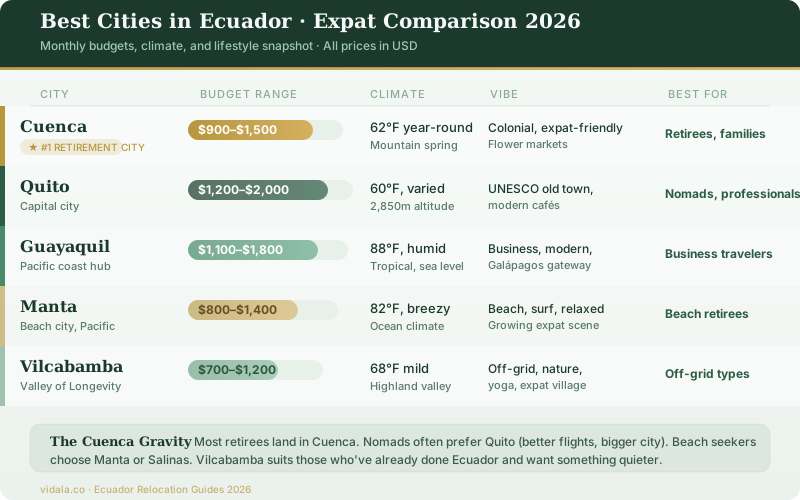
A few specifics worth knowing:
Groceries: Cuenca’s network of local markets (Mercado 10 de Agosto, Feria Libre) keeps produce prices low: $0.30 for a pound of tomatoes, $0.50 for avocados. The Supermaxi stocks US and European imports at premium prices; it’s where you go for cheese, wine, and brand-name products. Most expats split: local markets for produce and staples, Supermaxi for everything else.
Taxis: A taxi anywhere within central Cuenca runs $1.50–$3 by meter. Practically nowhere in the city costs more than $5. This makes car ownership optional in ways it isn’t in sprawling cities.
Dining: A set lunch (almuerzo), which includes soup, main course, juice, and dessert, at a local restaurant costs $2.50–$3.50. A mid-range dinner for two with wine: $25–$45. The restaurant scene has grown considerably; there are now decent Thai, Japanese, and Italian options alongside Ecuadorian food.
Trial first month: If you’re doing a scouting stay, budget $300–$500 on top of rent for one-time costs: SIM card ($5–$10 for Claro or Movistar), basic household supplies, a few day trips (Cajas National Park, Ingapirca). First month is more expensive than steady-state.
Healthcare in Cuenca
Cuenca has the best private healthcare infrastructure in Ecuador outside Quito. For many retirees, this is the deciding factor.
Private Hospitals
Hospital Santa Inés is the private hospital most expats use and trust. Seven floors, modern equipment, and a well-organized emergency department. Doctors are frequently trained in the US, Spain, or elsewhere abroad. Specialists across most major fields. Prices: doctor visits $30–$60, specialist consultations $50–$100, CT scans $80–$150 (vs. $800–$2,000 in the US). Many people think it’s the best private hospital in Cuenca.
Hospital Universitario del Río is Cuenca’s largest private hospital, with broader capacity and strong facilities for complex surgery. Located near the university district.
Hospital Monte Sinaí is known for cardiac care and has solid surgical facilities. Covered by Confiamed insurance network.
Clínica Santa Ana (Ordóñez Lasso area) is smaller and more clinic-like, good for routine care and close to the expat neighborhood.
All four have English-speaking staff, though the depth of English proficiency varies by doctor. Your immigration lawyer or expat community can refer you to specific physicians.
For complex surgery, transplants, or highly specialized oncology care, Quito is the answer. Cuenca’s private hospital network handles the vast majority of what expats need day-to-day, but it has limits. Know what those limits are before ruling out Quito access.
IESS: Ecuador’s Public Healthcare
Once you have legal residency, you can enroll in IESS (Ecuador’s social security/public health system). The contribution rate is approximately 17.6% of your declared income. If you’re declaring the minimum income threshold for your visa ($1,458/month), that works out to roughly $257/month in IESS contributions (or less if you’re on the minimum SBU of $486).
IESS covers medical care at public hospitals and clinics. Wait times are longer than private, but for routine care and prescriptions it works. Most expats use IESS as a backup and private hospitals for anything that matters to them.
Health Insurance for the Visa
Ecuador’s 2026 visa regulations require proof of health insurance coverage at the time of application: specifically, coverage that includes Ecuador. SafetyWing satisfies this requirement at around $47–$80/month depending on your age. Most first-year expats in Cuenca use SafetyWing for the visa application process, then evaluate longer-term options once they’re established: local plans through Confiamed or BUPA Ecuador run $150–$300/month for a couple and have better local network integration.
Dental Care
Cuenca has developed a genuine dental tourism reputation. A crown that costs $900–$1,500 in the US runs $200–$350 here. Implants: $700–$1,200 per tooth versus $3,000–$5,000 in the US. Root canals: $80–$150. The quality at established clinics is good, with many Cuenca dentists trained abroad or using US/European equipment and materials. Find Health in Ecuador Dental Clinic and Smile Health Ecuador Dental Clinic are among the operations with English-speaking staff and international-standard facilities. Expats in the Facebook groups can refer specific dentists based on personal experience; this is the most reliable vetting method.
Pharmacies
Farmacia Cruz Azul, Fybeca, and Medicity all have multiple branches in Cuenca. Generic medications run 50–80% cheaper than US equivalents. You can often buy medications here without a prescription that would require one at home; check with your doctor before doing this for anything significant.
Getting a Visa to Live in Cuenca
Since Cuenca is the destination, not the visa itself, the quick version here:
Pensioner (Jubilado) Visa: the most common for retirees. Requires $1,458/month in pension income (Social Security counts, as do pension distributions and qualifying income from retirement accounts). No age minimum. This is the path for most Americans 55+ moving to Cuenca.
Rentista Visa: for passive income (investment returns, rental income, dividends). Same $1,458/month threshold. No pension required. Works for early retirees with investment income.
Digital Nomad / Remote Worker: technically a subcategory of Rentista; same income threshold of $1,458/month from a foreign employer or freelance clients. Cuenca’s growing coworking scene and fiber internet make it increasingly viable for nomads.
Key 2026 Updates:
- All applications now submitted through Ecuador’s E-Visa system (online)
- Health insurance coverage required at application time
- Income threshold is $1,458/month (updated from earlier 2025 guidance)
- Processing: approximately 4–6 months total (document prep + 60–90 days processing + biometrics)
- Government fees: $50 application fee + $400 issuance fee + ~$15 cédula = ~$465 total
For the full document checklist, step-by-step process, all visa categories, and permanent residency pathway: Ecuador Visa Guide: All Options Explained 2026
The Expat Community: How It Actually Works
Cuenca has one of the most organized expat communities in Latin America. Here’s the real infrastructure:
CuencaHighLife.com: English-language local news site. Events calendar, local political coverage, classifieds. A daily read for many Cuenca expats.
Cuenca Expats on Facebook: 30,000+ members. Questions about doctors, plumbers, visa lawyers, restaurants; someone has answered it. Search before posting; the archive is extensive.
Cuenca Gringos: more active for local meetups and social events.
Gringo Tree: in-person social events, language exchanges, day trips. Good for meeting people in the first few weeks.
Monday morning coffee meetups: informal weekly gatherings at rotating cafés. Ask in the Facebook groups for the current location. This is genuinely the best way to meet people in your first month.
The community skews older, lots of retirees, which is either a feature or a drawback depending on your stage of life. The digital nomad contingent is growing but small compared to Medellín or Mexico City. If you’re 35 and working remotely, Cuenca can feel quieter socially than you want. If you’re 60 and retired, it’s about right.
Spanish: How Much Do You Actually Need?
More than Panama, less than smaller Ecuadorian towns. In Cuenca’s expat neighborhoods and at private hospitals, doctors, lawyers, and real estate agents often speak functional English. Service workers, taxi drivers, and local market vendors generally don’t.
For daily life, A2-level Spanish gets you through most situations. Reaching B1 within six months makes everything easier and considerably more enjoyable. Spanish classes in Cuenca run $5–$8/hour at established schools like Instituto Superior de Español or one-on-one with local tutors. The investment is worth it.
Cuenca as a Base: Day Trips and Regional Exploration
One of Cuenca’s underappreciated advantages is its position in the southern Andes. It’s a compact city with easy access to some genuinely remarkable places:
Cajas National Park — 30 minutes west of Cuenca by car or taxi. A high-altitude páramo landscape with over 200 lakes, dozens of hiking trails, and excellent trout fishing. Entry is free; guided hikes run $20–$40. It’s what Cuenca residents do on weekends.
Ingapirca — about 90 minutes north by bus or car. Ecuador’s most significant Inca archaeological site: a sun temple and complex that’s less touristed than Machu Picchu but architecturally interesting. Entry is around $2. Worth a day trip in your first month.
Loja — 3 hours south by bus. Another colonial highland city, quieter and cheaper than Cuenca, with its own small expat community. Worth a 2–3 day visit to understand the options.
The Ecuador coast — Cuenca sits about 4 hours from Puerto López on the Pacific coast. In whale watching season (June–September), humpback whales congregate just offshore, one of the most accessible whale-watching experiences in South America.
Baños (Tungurahua) — 6–7 hours north, near an active volcano. Adventure sports, thermal baths, taffy shops. Doable as a long weekend.
Having Cuenca as a home base while exploring Ecuador is a genuine lifestyle advantage over cities that are more peripheral to the country’s main tourism infrastructure.
Getting Around Cuenca
Walking works well for El Centro and El Ejido residents; less so for Ordóñez Lasso and the outer neighborhoods.
Taxis: $1.50–$3 anywhere within the central city, metered. InDriver and other apps operate in Cuenca as well, usually at slightly lower prices than hailed taxis.
Public bus: $0.30/ride, covers the whole city. Useful but slow. Learn the routes and it becomes practical for regular journeys.
Tranvía: Cuenca’s tram system connects Ordóñez Lasso to El Centro and beyond. Inexpensive and reliable for that corridor.
Car: not needed for the first year if you’re in a walkable neighborhood. Useful for exploring the region: Cajas National Park is 30 minutes west, Ingapirca is about 90 minutes north, Loja is 3 hours south. Parking in El Centro is frustrating enough that most expats who own cars park them at home and use taxis downtown.
Honest Cons of Living in Cuenca
Altitude. 2,550 meters is real. Acclimatization takes 2–4 weeks for most people: expect fatigue, headaches, and shortness of breath on arrival. People with serious heart or lung conditions should consult a physician before committing to a long-term stay. This isn’t a dealbreaker for most, but it’s a factor worth knowing before you book a one-way flight.
Getting to the US takes effort. Cuenca’s Mariscal Lamar Airport (CUE) has limited domestic routes, mainly to Quito and Guayaquil. From there, you connect internationally. Door-to-door from Cuenca to a US city is typically 8–12 hours minimum. For people with family emergencies or who need to be back home quickly, this is a practical limitation.
Healthcare ceiling. Cuenca’s hospitals handle the vast majority of what expats need. But they have capacity limits. Complex surgery, certain oncology treatments, or specialized diagnostics that don’t exist in Cuenca mean traveling to Quito or, in some cases, the US. Know this before you have a health crisis.
Nightlife and social scene are limited. Cuenca closes early compared to Medellín, Panama City, or Bogotá. Good restaurants, some live music, bars that close by midnight on weekdays. If an active social night scene is important to you, Cuenca will feel like a slow town. Most residents who love it are fine with this trade-off.
Spanish dependency. Unlike Panama City’s expat neighborhoods, Cuenca requires more Spanish for daily life. You can get by without it, but you’ll feel the limitation.
Frequently Asked Questions
Is Cuenca safe?
Very safe by Latin American standards. It consistently ranks among Ecuador’s safest cities. The main expat neighborhoods (El Centro, Ordóñez Lasso, El Ejido, Puertas del Sol) have low street crime. Normal precautions apply: don’t flash expensive cameras, use taxis at night rather than walking unknown streets. Ecuador has seen increased crime in Guayaquil and some Quito areas since 2022; Cuenca has remained relatively insulated from this trend. Ask in the Facebook groups for current neighborhood-specific updates before settling on a specific area.
Can I fly directly to Cuenca from the US?
No. Mariscal Lamar Airport (CUE) handles domestic flights to Quito and Guayaquil, plus some regional routes. From Quito (UIO) or Guayaquil (GYE), you connect to US hubs: Miami, Atlanta, Houston, JFK. Total travel time from a US city to Cuenca is typically 8–12 hours depending on connections.
What’s the best neighborhood for first-timers?
El Centro for a 1–3 month trial stay; walkability and cultural immersion make it the best place to orient yourself. Ordóñez Lasso for longer-term living; the infrastructure and quality of life are better suited to years, not months.
Is Cuenca viable for digital nomads?
Yes, with caveats. Fiber internet is established in Cuenca’s expat neighborhoods; 50–100 Mbps speeds are typical in good apartments, which handles video calls and large uploads reliably. Coworking spaces include Impaqto (the most established chain) and a handful of independent cafés that cater to remote workers. The cost is lower than Medellín or Panama City. The social scene for younger digital nomads is thinner. For async work with occasional video calls and a low monthly budget priority, Cuenca is excellent. For people who want a buzzing nomad social scene, Medellín is probably the better fit.
Do I need a car in Cuenca?
Not in your first year, especially if you’re in El Centro or El Ejido. Taxis are cheap enough that car ownership doesn’t save money until you’re doing regular regional travel. Once you’re established, a car opens up Cajas, Ingapirca, and weekend trips to the coast (about 4 hours). Many long-term Cuenca expats eventually buy one.
What Your First Month Actually Looks Like
If you’re doing a scouting or trial stay, here’s a realistic budget:
| Item | Cost |
|---|---|
| Furnished 1BR apartment (El Centro/El Ejido, 1 month) | $500–$700 |
| Groceries + dining (mix of local and mid-range restaurants) | $400–$600 |
| Transportation (taxis, occasional bus) | $60–$100 |
| SIM card (Claro or Movistar, 10GB data) | $10–$15 |
| Spanish class (10 hours) | $60–$80 |
| Cajas National Park day trip | $30–$60 including guide |
| Ingapirca day trip | $30–$50 |
| Miscellaneous (household supplies, pharmacy, etc.) | $100–$200 |
| Total first month | $1,190–$1,805 |
That’s a representative trial stay budget. By month two or three, you’ll have established a grocery routine, a neighborhood preference, and a sense of whether you’re staying. Most people who spend a month in Cuenca know by week three whether it’s for them.
Book a furnished short-term rental in El Centro or El Ejido through Booking.com, filter for monthly rates (substantially lower than nightly rates) and look for “long-term rental” tags. SafetyWing gives you healthcare coverage from day one for $47–$80/month. Transfer money to your Ecuadorian account via Wise to avoid the 3–5% bank wire fees.
Concrete Next Steps
- Book a 3–4 week trial stay: furnished apartment in El Centro or El Ejido; do not sign a 6-month lease without living there first
- Show up at the Monday expat meetup in week one; ask in the Cuenca Expats Facebook group for the current location. This is the single highest-value social move you can make on arrival
- Get the visa process started early: document apostilling and gathering takes 2–3 months before you even file; don’t wait until you’ve decided to move
- Consult an immigration lawyer before applying: the E-Visa system has specific document requirements that catch people out; $500–$1,500 in legal fees prevents a rejected application
- Visit Ordóñez Lasso and El Centro in the same trip; know which neighborhood style fits before committing to a long-term lease
For everything about Ecuador’s visa process: Ecuador Visa Guide: All Options Explained 2026
For how Cuenca compares to Quito on cost: Cost of Living in Quito, Ecuador
For the full Ecuador picture: Moving to Ecuador: Complete Guide 2026