
Banking in Ecuador for Expats: The 2026 Guide
Ecuador runs on US dollars. For American expats, that sounds like it simplifies everything; no currency conversion, no exchange rate stress, and your ATM card works from day one. In practice, the dollar economy does make Ecuador more accessible than most of Latin America. But it doesn’t give you instant access to a local bank account.
Here’s the thing most guides don’t mention upfront: opening a bank account at an Ecuadorian bank requires a cedula de extranjería: your Ecuadorian residency card, and you only get that after your visa is approved and processed. For most new arrivals, that means 4–8 months of living without a local account. This is not a crisis. With the right tools, you can function completely fine. But you need to plan for it.
This guide covers both phases: what to use while you’re waiting on your cedula, and how to open a local account once you have it.
The Dollar Economy: Advantage and Limitation
Ecuador adopted the US dollar as its official currency in 2000, following a severe financial crisis. For expats, this is genuinely useful. You don’t lose money on every ATM withdrawal through conversion fees. Your Social Security deposit or wire from the US arrives as dollars and gets spent as dollars. When you’re comparing rents or grocery prices, the math is intuitive.
But “dollarized” doesn’t mean “just like the US.” Ecuador’s banking system operates under its own regulations, its own KYC requirements, and its own identity infrastructure. The cedula isn’t just an ID card; it’s Ecuador’s way of verifying that you’re a legal resident with a documented address, a verified income source, and a legitimate reason to be there. Banks require it partly by regulatory mandate and partly because the AML (anti-money-laundering) environment in Latin America is strict.
So yes, your US dollars work everywhere. Your US bank structure, however, does not transfer automatically.
The Cedula Requirement: The Central Constraint You Need to Understand
Most Ecuadorian banks; Banco Pichincha, Banco Guayaquil, Produbanco, Banco del Pacífico; require a cedula de extranjería before they’ll open a personal account. There are no informal workarounds here. If you walk in with just your passport, the answer at most branches will be no.
The cedula arrives in two stages:
- Visa approval: Processing typically takes 2–4 months depending on the visa type (Jubilado/retirement, digital nomad, professional, investor). The digital nomad visa tends to be faster; investor visas can take longer.
- Cedula processing: After visa approval, you apply for the cedula at a Registro Civil office. This adds another 1–3 months. Cuenca’s office tends to be faster than Quito’s.
Put it together: plan for 4–8 months from arrival to your first local bank account. That’s not a worst-case estimate; it’s a realistic middle range. Start your visa application as early as possible. Every month you delay is another month operating without local banking access.
Don’t let this number alarm you. The bridge banking tools below make Ecuador genuinely manageable in the meantime.
Bridge Banking: What to Use Before Your Cedula Arrives
This is the section that solves most people’s immediate problem. These two tools together cover 95% of daily banking needs in Ecuador, including paying rent, utilities, and routine expenses.
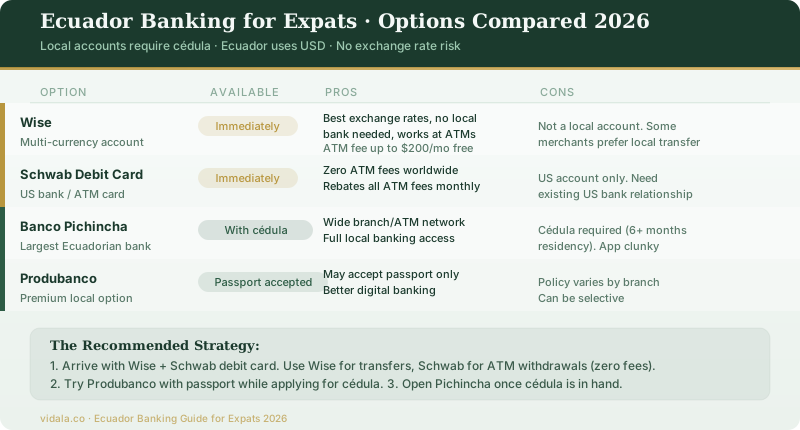
Wise: Set This Up Before You Leave
Wise is the single most useful financial tool for Ecuador-bound expats. Open your account before you leave the US; it takes 15 minutes online and doesn’t require a foreign address. Once you’re there, it functions as a near-complete banking solution.
A few specifics on why Wise works so well in Ecuador:
- USD-to-USD transfers are cheap. Since Ecuador uses dollars, you’re not converting currencies when you send money to an Ecuadorian landlord or service provider. Wise’s fee for USD-to-USD transfers runs around 0.5–0.7%.
- The debit card works at ATMs across Ecuador. You can load it from your US bank account and withdraw dollars anywhere Visa or Mastercard is accepted.
- You can pay Ecuadorian recipients directly. Many landlords and service providers accept Wise transfers. It’s faster and cheaper than an international wire.
- No surprise fees. The mid-market exchange rate applies if you ever do need to convert currencies.
Set this up now, even if you’re not moving for months. You’ll want the account active and verified before you land.
Charles Schwab High Yield Investor Checking: The Best ATM Card for Ecuador
Schwab’s checking account reimburses all ATM fees, worldwide, with no cap. That matters in Ecuador because ATM fees are not trivial: Banco Pichincha charges around $4.60 per withdrawal, Banco Guayaquil around $3.51, and Banco Internacional typically nothing. Schwab refunds these charges at the end of each month.
There’s no monthly fee, no minimum balance, and you can apply from the US before you move. Pair it with a US bank account and Wise and you have a complete pre-cedula banking setup.
One important ATM note: always choose to be charged in USD when an ATM offers Dynamic Currency Conversion (DCC). If you accept DCC, the ATM sets the exchange rate; not favorable, and Schwab won’t reimburse those fees because it looks like a currency conversion charge, not a standard ATM fee.
Your US Bank Account: Keep It
Don’t close your US bank account before moving. You need it for IRS reporting purposes, as a funding source for Wise and Schwab, and as an emergency reserve. Keep at least 3–5 months of living expenses in a US account. Wire transfers from US banks to Ecuadorian attorneys and businesses are also possible; $25–$45 per transfer, and occasionally necessary for things like real estate purchases or large deposits.
ATMs in Ecuador: Practical Coverage
ATM availability across Ecuador is good in the main expat cities but thins out in rural areas.
In Quito, ATMs are everywhere; Banco Pichincha, Produbanco, Banco del Pacífico, Banco de Guayaquil in the financial district, Mariscal Sucre, and most shopping centers. In Cuenca, the Historic Center and Yanuncay neighborhoods have solid ATM coverage. Guayaquil is a major city with full coverage. Manta, Loja, and other secondary cities have ATMs at banks and supermarkets but fewer options.
The gaps appear in the Amazon region and rural coastal areas. If you’re spending time in Baños, Puerto López, or small highland towns, carry sufficient cash before you head out. There’s often one ATM in a remote town, and it may have a $200 withdrawal limit.
Standard withdrawal limits: $200–$500 per transaction, typically $500–$1,000 per day across multiple withdrawals.
Opening a Local Account: Once Your Cedula Arrives
Once you have your cedula, the account-opening process is straightforward at most banks. Expect 30–60 minutes at the branch. Here’s what to bring:
Standard document checklist:
- Cedula de extranjería (original + two color copies)
- Valid passport (original + two copies of main page and Ecuador entry stamp page)
- Proof of address; utility bill or signed lease from the past 90 days; if the bill isn’t in your name, bring the owner’s cedula and a signed authorization letter
- Proof of income; pension statement, employment letter, or 3–6 months of bank statements showing regular deposits
- RUC number (Registro Único de Contribuyentes); Ecuador’s taxpayer ID, obtainable from SRI once you have a cedula; required by some banks, not all
Bring originals and copies. Make more copies than you think you need.
Banco Pichincha: Best Overall for Expats
Pichincha is Ecuador’s largest private bank and the top recommendation for most expats. It has the widest ATM network in the country, which matters if you travel between regions. Some branches in Quito (the financial district on Av. Amazonas) and Cuenca (near Parque Calderón) have English-speaking staff; not guaranteed, but more common here than elsewhere.
Opening a basic savings account requires around $20–$50 as an initial deposit. Monthly fees are low. The mobile app and online banking work reliably.
The knock against Pichincha: like most large Ecuadorian banks, it can be rigid at certain branches. If one location turns you away over a minor document issue, try another branch before giving up.
Produbanco: Good for Professionals and Business
Produbanco is well-regarded for its online banking platform and serves a lot of business-oriented expats and professionals. The documentation requirements are similar to Pichincha’s. Some expats report that Produbanco asks for proof of Ecuadorian-based income, which is a higher bar; retired expats with foreign pension income sometimes find Pichincha more straightforward.
Cooperativa JEP: Best Option Pre-Cedula in Cuenca
This is the standout exception to the cedula rule, and it matters. Cooperativa JEP (Juventud Ecuatoriana Progresista) is a credit union based in Cuenca that will open a savings account with just a passport; no cedula required. Minimum deposit is $20, with $10 kept as a permanent minimum balance.
If you’re based in Cuenca and need a local account before your cedula arrives, this is your path. Walk in and ask to speak directly with the platform services supervisor or branch manager (Jefe de Agencia); they have the authority to handle non-standard applications. Regular tellers may not know the process for foreigners.
JEP won’t give you a credit card or loan without residency, but for day-to-day transfers and payments, a savings account with a debit card covers most needs.
Banco del Pacífico: Government-Affiliated, Wider Rural Presence
Banco del Pacífico is partially state-owned and has a solid ATM network, particularly in coastal cities and smaller towns where private banks are thinner on the ground. Some expats find the account-opening process easier here after a long wait. The trade-off: the online banking experience is less polished than Pichincha or Produbanco.
Banco Guayaquil: Best for the Coast
If you’re based in Guayaquil, Manta, or coastal areas, Banco Guayaquil is worth considering. It has a good mobile app and strong coastal coverage. Document requirements are similar to other private banks; cedula required, proof of income, proof of address.
Sending Money Between Ecuador and the US
Most expats maintain both US and Ecuadorian accounts and move money between them regularly. Here’s what actually works:
US to Ecuador:
- Wise is the cheapest option for USD-to-USD transfers. If you’re sending to a local Ecuadorian bank account, the fee runs around 0.5%. Typically delivers within minutes.
- Bank wire from a US bank: $25–$45 sending fee, plus possible intermediary bank fees. Takes 1–3 business days. Reliable for large amounts where the fixed fee is a smaller percentage.
- Zelle: doesn’t work for Ecuador-based recipients. Ecuador isn’t in the network.
- PayPal: available but fees are high for personal-to-business transfers. Use it only if you have no other option.
Ecuador to US:
- Wise remains the best option if you have a linked Ecuadorian bank account.
- Wire transfer from an Ecuadorian bank: $15–$30 fee from the local bank, plus possible US intermediary fees. Expect 3–5 business days.
If you’re repatriating larger sums or managing Social Security deposits, set up an automatic Schwab ATM withdrawal cadence or a monthly Wise transfer to cover your Ecuador expenses, and leave the rest in the US account.
IESS: The Social Security Side Note
If you’re employed by an Ecuadorian company or choose to voluntarily enroll in IESS (Instituto Ecuatoriano de Seguridad Social), the national social security system, some banks will reference IESS enrollment as an additional proof of residency when opening accounts. IESS enrollment requires a cedula, so this is relevant only after you’ve reached that stage. It’s also the path to accessing Ecuador’s public healthcare system at very low cost; separate from banking but often comes up in the same conversation. See our Ecuador Healthcare guide for details.
Common Problems and How to Handle Them
“My landlord won’t accept international transfers; only local bank transfers.” Use Wise to send directly from your Wise balance to their Ecuadorian account. Wise handles domestic Ecuador transfers. If they specifically want a local bank transfer and you don’t have a local account yet, ask about cash payment as an interim arrangement. Most landlords dealing with expats have encountered this before.
“I can’t figure out how to pay utilities without a local account.” Most utility providers in Ecuador accept cash payment at service offices or authorized collection points. CNT (internet/phone), EEQ (Quito electricity), and CENTROSUR (Cuenca electricity) all have in-person payment options. Some also accept Visa/Mastercard from international cards. Local account makes this easier, but it’s not the only path.
“My US bank charges $5 every time I use an ATM here.” Get the Schwab debit card. This is exactly what it’s designed for. Once you have it, ATM fees disappear from your Ecuador cost of living.
“A bank turned me away even though I have my cedula.” Try a different branch. Branch-level discretion is real at Ecuadorian banks, and two branches of the same bank can give you different answers. If one Pichincha branch says no, try the one on the next block. If the whole bank is unworkable, move to the next option on the list.
Frequently Asked Questions
Can I open a bank account in Ecuador without a cedula? At most banks, no. The exception is Cooperativa JEP in Cuenca, which will open a savings account with just a passport. A few other cooperativas are reportedly flexible, but JEP is the most reliably expat-friendly option.
How long does it take to get a cedula after my visa is approved? Typically 1–3 months at a Registro Civil office. Cuenca tends to process faster than Quito. Bring your visa approval documentation, passport, and proof of address.
Are ATMs safe to use in Ecuador? Generally yes in expat areas. Use ATMs inside bank branches or shopping malls rather than freestanding street ATMs. The standard precautions apply: shield your PIN, be aware of your surroundings, withdraw during daylight. Quito’s Mariscal and La Floresta neighborhoods, Cuenca’s Historic Center, and Guayaquil’s Urdesa and Kennedy Norte are all low-concern ATM environments.
Can I use Venmo or Zelle in Ecuador? No. Both require US-based recipients. Wise is the direct replacement for Ecuador-based transfers.
Do I need to report my Ecuadorian bank account to the IRS? As a US citizen or permanent resident, you still have FBAR and FATCA reporting requirements. If your Ecuadorian account exceeds $10,000 at any point in the year, you must file an FBAR. Get this advice from a US tax professional with expat experience: the rules are straightforward but the penalties for non-filing are not.
Putting It Together
Ecuador’s dollar economy is a genuine advantage; you won’t deal with exchange rate swings or conversion math on everyday purchases. The cedula requirement adds a delay, but it’s a manageable one.
The practical setup:
- Open Wise now, before you leave
- Get the Schwab checking account
- Keep your US account active with a few months of reserves
- Start your visa application early: the cedula clock doesn’t start until the visa is approved
- Once you have your cedula, head to Banco Pichincha (or Cooperativa JEP if you’re in Cuenca and couldn’t wait)
Most Ecuador expats settle into this rhythm within a few months and find it less stressful than they expected. The Wise + Schwab combination genuinely covers daily life, and the local account is more of a convenience upgrade than a necessity.
For the full relocation picture, start with our Moving to Ecuador guide and Ecuador Visa Guide: the cedula timeline fits directly into the visa process, and the sooner you understand both, the better positioned you’ll be.